What are the Types of Learning?
When we probe into the realm of “types of learning,” it’s essential to start with a fundamental understanding of what learning itself entails. Learning is a dynamic and continuous process of acquiring, understanding, and applying various forms of knowledge, behaviors, skills, and values. This complex process is influenced by an individual’s cognitive abilities, social environment, emotional responses, and physical capabilities.
Definition of Types of Learning
In the simplest terms, learning can be defined as the process by which a person assimilates information, ideas, and experiences and subsequently applies them to new situations. This broad definition encompasses everything from memorizing facts or mastering a skill, to adopting a new belief or behavior. In the context of “types of learning,” this definition broadens to include various methodologies and frameworks through which learning can occur, ranging from structured environments like classrooms to the natural acquisition of behaviors from one’s environment.
Importance of Understanding Different Types of Learning
Exploring and understanding the different “types of learning” is crucial not just for educators and trainers, but for anyone looking to enhance their personal or professional life. Each type of learning—from visual and auditory to kinesthetic and digital—caters to different preferences and cognitive styles, which can significantly affect how effectively an individual learns. By recognizing and employing different types of learning, educators can design more effective teaching methods, professionals can improve their skills more efficiently, and individuals can better adapt to the demands of modern life.
For instance, knowing whether a visual or a hands-on learning style is more effective for a particular individual can help tailor educational and training programs to be more impactful. Moreover, in an increasingly digital world, understanding and leveraging the correct type of learning can lead to more engaging and successful outcomes in both academic and professional fields.
Basic Types of Learning
Exploring the “types of learning” allows us to understand how different methods and environments influence our ability to acquire and apply knowledge. This section of the blog will break down some foundational types of learning: classical conditioning, operant conditioning, observational learning, and the distinction between informal and formal learning. Each type plays a critical role in shaping educational strategies and personal development.
Classical Conditioning
Classical conditioning is a type of learning that associates an involuntary response and a stimulus. This concept was famously demonstrated by Ivan Pavlov in his experiments with dogs. In the realm of “types of learning,” understanding classical conditioning helps educators and psychologists predict and modify behaviors through association, making it a fundamental principle in behavioral psychology. For example, this can be applied in developing habits or changing emotional responses to specific stimuli, which are common queries among those studying behavioral triggers and responses.
Operant Conditioning
Another pivotal type of learning is operant conditioning, introduced by B.F. Skinner, which involves learning through the consequences of behavior. This method is characterized by reinforcement (positive or negative) that increases the likelihood of a behavior being repeated, and punishment, which decreases its occurrence. In practical settings, operant conditioning is extensively used to shape behavior in educational environments, therapy, and even animal training. Understanding this type of learning is essential for anyone looking to implement behavioral change strategies effectively.
Observational Learning
Observational learning, or social learning, occurs when individuals learn by watching others, then imitating or modeling the observed behaviors. Albert Bandura’s research highlights the importance of this type of learning, especially in children. It is particularly relevant today with digital media, where much of the content consumed includes models and behaviors that viewers might imitate. Observational learning is a key component in discussions about the influence of media on behavior, making it a crucial topic for educators, parents, and media creators.
Informal vs. Formal Learning
The distinction between informal and formal learning is crucial in understanding the full spectrum of “types of learning.” Formal learning occurs in a structured, often institutional context, and is guided by curricular goals, such as in schools and training programs. In contrast, informal learning is unstructured, does not occur in an educational institution, and often does not have a set curriculum. Examples include learning through life experiences, social interactions, and hobbies. Recognizing the value and characteristics of each can help individuals of all ages and backgrounds adapt learning strategies to suit their needs and environments.
Cognitive Learning Theories
In the exploration of “types of learning,” cognitive learning theories play a vital role in understanding how the mind processes, stores, and retrieves information. These theories provide insights into the mental activities that underpin learning and knowledge acquisition. This section will delve into two significant cognitive learning theories: constructivism and information processing theory, both of which are fundamental to developing effective educational strategies and understanding human cognition.
Constructivism
Constructivism is a “type of learning” theory that posits learners actively construct their own understanding and knowledge of the world, through experiencing things and reflecting on those experiences. It suggests that people create their own understanding and knowledge of the world, through the interaction between their ideas and their experiences. Jean Piaget, who articulated stages of cognitive development, and Lev Vygotsky, who introduced social components to constructivism, significantly influenced this theory. In practical applications, constructivism influences modern educational practices by encouraging interactive, student-centered learning environments where learners engage with material, collaborate with others, and apply their knowledge in contextually meaningful ways. This theory is particularly relevant to educators and trainers looking to create more engaging, effective educational experiences tailored to the learner’s active participation in the learning process.
Information Processing Theory
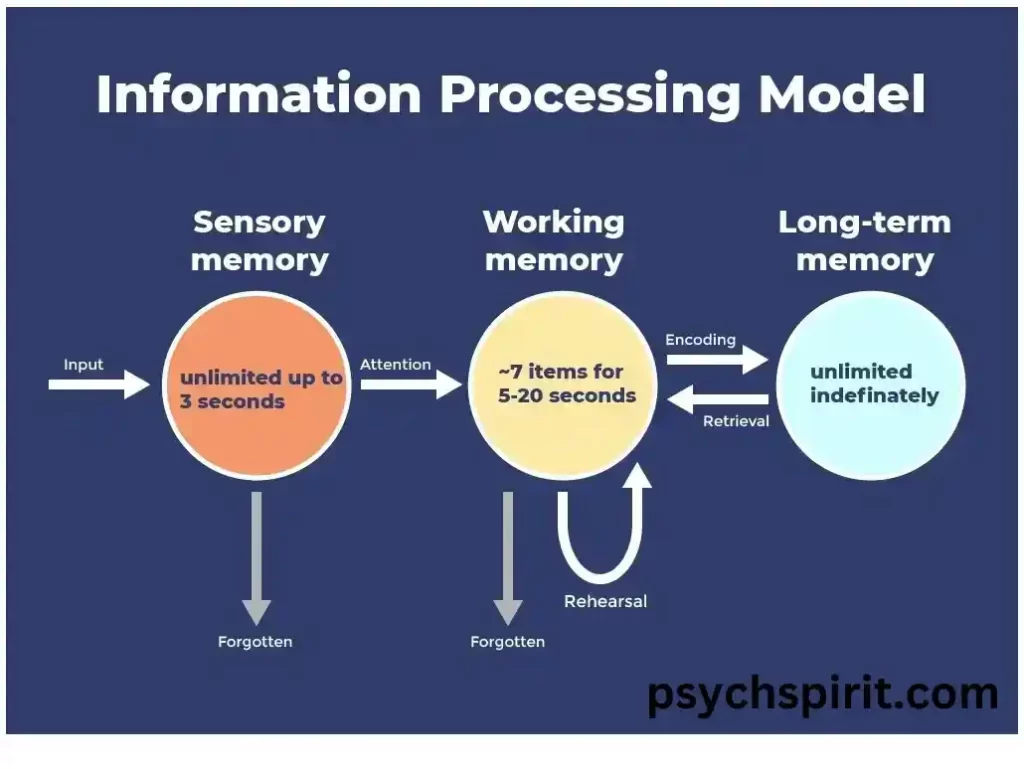
Information processing theory, another influential “type of learning” theory, offers a framework for understanding how the human mind processes incoming information, stores it, and retrieves it when necessary. This theory likens the human mind to a computer, emphasizing how information is input, processed, stored, and output by the brain. Key elements include sensory memory, working memory, and long-term memory, each playing a crucial role in the learning process. For instance, strategies to enhance memory retention such as chunking and the use of mnemonic devices are grounded in information processing theory. This theory is instrumental for anyone looking to improve cognitive functions, enhance teaching methods, and understand how technology can aid in managing cognitive load in learners.
Social Learning
In our comprehensive exploration of “types of learning,” social learning stands out as a crucial component, influencing how individuals acquire new behaviors, skills, and attitudes from observing others. This section delves into the specifics of Social Learning Theory and the dynamics of group learning, both of which are instrumental in understanding learning within social contexts. These concepts are particularly relevant in educational settings, workplace training, and online platforms, where interaction plays a pivotal role in learning outcomes.
Social Learning Theory
Social Learning Theory, developed by Albert Bandura, posits that people learn from one another through observation, imitation, and modeling. This “type of learning” goes beyond traditional behavioral theories that require reinforcement for learning to occur, suggesting that the social environment and cognitive processes also play significant roles in learning. Bandura’s theory is especially relevant in the digital age, where social media and online video platforms demonstrate learning through observation on a massive scale. For educators, understanding Social Learning Theory can help in designing more effective educational environments that encourage positive behavioral modeling and peer interaction. It also answers prevalent user queries about the impact of media on learning and the role of observation in acquiring new knowledge or skills.
Group Learning Dynamics
Group learning dynamics refer to the processes and interactions that occur when learning takes place in group settings. This “type of learning” emphasizes the impact of group interaction on the learning process, including collaboration, communication, and conflict resolution. In educational and professional settings, group learning can enhance problem-solving skills and deepen understanding through diverse perspectives. For instance, collaborative projects or study groups leverage group dynamics to foster deeper learning and retention of information. Understanding these dynamics is crucial for teachers, trainers, and leaders aiming to create effective teams and learning groups.
Both Social Learning Theory and the study of group learning dynamics offer valuable insights into how individuals learn in social settings. These frameworks not only support the design of learning environments that are interactive and collaborative but also help in tailoring content delivery to enhance learning outcomes in group contexts. By focusing on these “types of learning,” content creators and educators can address common queries about the effectiveness of group studies and the influence of observational learning, ensuring that the material is both SEO-optimized and profoundly useful to readers seeking to understand or enhance learning in social contexts.
Experiential Learning
Experiential learning is a vital “type of learning” that emphasizes the role of experience in the learning process. This approach to learning is particularly engaging because it allows learners to apply theoretical knowledge in real-world scenarios, thereby enhancing understanding and retention. This section will provide a comprehensive overview of experiential learning, including its definition, practical examples, and an exploration of Kolb’s Experiential Learning Cycle, all of which are pivotal for students, professionals, and educators seeking practical and impactful learning methods.
Definition and Examples on Types of Learning
Experiential learning involves learning through reflection on doing, which is distinct from rote or didactic learning. This “type of learning” is highly effective because it enables learners to engage directly with the materials, participate actively, and learn from their experiences. Examples of experiential learning include internships, field trips, hands-on workshops, and simulation exercises. For instance, medical students often participate in clinical rounds, learning through direct patient care under supervision, which embodies experiential learning by integrating theory with practice. This approach not only helps in solidifying theoretical knowledge but also enhances skills in a practical environment, addressing common queries related to the application of knowledge in real-life situations.
Kolb’s Experiential Learning Cycle
David Kolb’s Experiential Learning Cycle is a renowned model that outlines the process of learning from experience. This model comprises four stages: Concrete Experience, Reflective Observation, Abstract Conceptualization, and Active Experimentation. Each stage plays a crucial role in the learning process:
- Concrete Experience – Learners encounter new experiences or reinterpret existing experiences.
- Reflective Observation – Learners reflect on the experience from different angles.
- Abstract Conceptualization – Learners develop new ideas or modify existing abstract concepts based on their reflection.
- Active Experimentation – Learners apply their ideas to the world around them to see what results.
By knowing and applying Kolb’s cycle can significantly enhance educational programs and training sessions by structuring them in a way that supports meaningful learning experiences. This model is particularly useful for educational designers and trainers looking to create learning modules that encourage critical thinking and active participation.



Digital Learning
In today’s interconnected world, “types of learning” have expanded to include digital formats that cater to the evolving needs of modern learners. Digital learning encompasses various methods through which knowledge is imparted using digital tools and content, offeritng flexibility, accessibility, and a wide range of resources. This section will explore the main facets of digital learning—e-learning, mobile learning, and blended learning models—highlighting how these approaches meet the needs of diverse learners and providing practical insights into their implementation.
E-Learning
E-learning refers to a formalized teaching system based primarily on electronic resources. While it can occur inside or outside classrooms, the key component is the use of computers and the Internet. This “type of learning” has transformed educational environments, allowing for self-paced learning and access to a wealth of resources and courses that might not be available locally. E-learning is particularly beneficial in corporate training and higher education, where it can be scaled to accommodate many learners without additional cost. Examples include online courses, virtual classrooms, and digital collaboration platforms. For those searching for effective ways to engage with course material online or integrate e-learning into their teaching practices, understanding the scope and tools of e-learning is essential.
Mobile Learning
Mobile learning, or m-learning, involves learning across multiple contexts through social and content interactions using personal electronic devices. This “type of learning” is characterized by the ability to learn anywhere and at any time, which breaks down the traditional barriers of classroom-based learning. Mobile learning is increasingly popular due to the widespread adoption of smartphones and tablets. It supports a range of features like podcasts, apps, and videos that make learning flexible and interactive. For learners and educators looking for solutions that accommodate busy schedules and enhance engagement outside the traditional classroom, mobile learning offers compelling strategies.
Blended Learning Models
Blended learning models integrate traditional face-to-face classroom methods with online digital media. This “type of learning” optimizes integration by allowing both teachers and students to manage how, when, and where they engage with the learning material, blending the best aspects of both physical and digital learning environments. Examples of blended learning can range from flipping the classroom, where students watch lectures at home and engage in activities in class, to integrating interactive assessments and tracking through Learning Management Systems (LMS). Blended learning is particularly effective in personalizing learning experiences and supporting diverse learning styles and needs.
Conclusion
As we’ve explored the diverse “types of learning,” it’s clear that each method offers unique benefits and caters to different educational needs and preferences. This exploration has provided insights into classical and operant conditioning, observational learning, cognitive learning theories, social learning, experiential learning, and the various modes of digital learning. Understanding these types not only enhances educational practices but also personalizes learning experiences, ensuring that learners of all ages and backgrounds can achieve their full potential.
FAQs
See More
Liaison Command
Unit: Dr. Sarfraz Ahmad // Secure Uplink
You may find more information on Types of Learning