Introduction to Gestalt Principles
Gestalt principles are foundational concepts in psychology that explain how people perceive and organize visual information into meaningful patterns or wholes. These principles originated from the Gestalt school of psychology, which emerged in the early 20th century in Germany. Researchers like Max Wertheimer, Wolfgang Köhler, and Kurt Koffka developed these ideas to understand how humans naturally organize sensory input, emphasizing that “the whole is greater than the sum of its parts.” The term “Gestalt” itself means “shape” or “form” in German, reflecting the emphasis on holistic perception.
Defining Gestalt Principles and Their Origin
Gestalt principles are rules that describe how our minds group and interpret sensory information to form coherent perceptions. They explain why we instinctively group objects based on proximity, similarity, continuity, closure, and other factors. For example, when looking at a dotted outline of a circle, the mind perceives it as a complete circle even though it’s incomplete. This ability to mentally fill in gaps showcases the innate workings of Gestalt principles.
The origin of Gestalt principles dates back to the 1910s when Max Wertheimer conducted experiments on apparent motion, a phenomenon where stationary objects appear to move when presented in succession. This research laid the groundwork for understanding how perception is not simply the sum of individual sensory inputs but an organized process influenced by these innate principles.
Importance of Gestalt Principles in Psychology
Gestalt principles hold immense importance in psychology because they reveal the processes behind human perception, cognition, and decision-making. They bridge the gap between how the brain interprets raw sensory data and how it organizes that data into meaningful experiences.
Understanding Visual Perception: Gestalt principles help psychologists explain why humans perceive patterns and structures in seemingly random stimuli. This insight is crucial for fields like cognitive psychology, where understanding perception aids in exploring attention, memory, and learning.
Applications in Therapy: Gestalt principles also influence therapeutic practices, especially in Gestalt therapy. This approach encourages individuals to focus on present experiences, integrating perception and action for personal growth.
Cognitive and Social Insights: These principles provide insights into how people process social cues, make decisions, and solve problems. For instance, they explain how individuals interpret facial expressions and group dynamics based on patterns and similarities.
By studying Gestalt principles, psychologists better understand the fundamental mechanisms of the human mind and their impact on behavior.
Overview of Their Application in Perception and Problem-Solving
Gestalt principles are widely applied in understanding perception and solving problems, particularly in areas requiring pattern recognition and organization.
Visual Perception: In visual perception, Gestalt principles explain phenomena like figure-ground relationships, where the brain distinguishes an object (figure) from its background (ground). This principle is crucial for recognizing faces, reading text, or interpreting complex images.
Problem-Solving and Decision-Making: Gestalt principles are also pivotal in problem-solving, helping individuals group related information to see the bigger picture. For instance, when solving puzzles, the brain instinctively applies principles like closure to complete patterns or continuity to connect fragmented information.
Applications in Design and Technology: Beyond psychology, Gestalt principles are extensively used in fields like graphic design, user interface (UI) design, and advertising. Designers apply these principles to create intuitive layouts that guide users naturally, improving usability and engagement.
Educational and Learning Contexts: In educational settings, Gestalt principles are employed to structure content in ways that enhance comprehension and retention. For example, grouping related ideas visually or conceptually aligns with the principle of proximity.
Core Principles of Gestalt Psychology
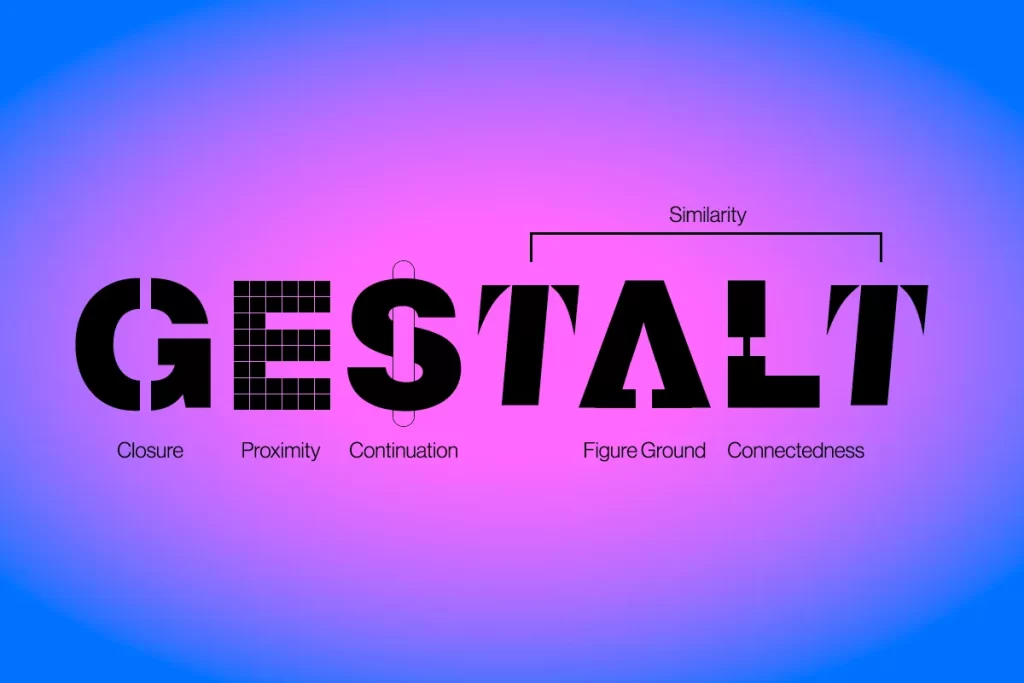
Gestalt principles are fundamental guidelines explaining how humans perceive and organize sensory information into meaningful patterns. These principles reveal how the mind naturally interprets complex visuals by simplifying and grouping elements based on specific rules. Below, we explore the core Gestalt principles with practical explanations and examples, demonstrating their relevance in understanding human perception.
1.Law of Proximity
The Law of Proximity states that objects or elements close to each other are perceived as part of the same group. This principle highlights how spatial closeness influences perception, often overriding other visual cues like color or shape.
Explanation with Examples:
Text Grouping: In a document, lines of text are perceived as separate paragraphs because of the spacing between them, not necessarily because of formatting.
Design Applications: On a website, buttons grouped closely together are interpreted as part of the same functionality, such as a navigation menu.
Everyday Observation: In a classroom, students sitting close together are often perceived as friends or part of a group.
The Law of Proximity is crucial in visual design, as it guides the arrangement of elements to ensure users perceive related items as part of the same context.
2.Law of Similarity
The Law of Similarity asserts that elements sharing similar attributes, such as color, shape, size, or texture, are perceived as belonging to the same group. This principle emphasizes the brain’s tendency to organize visuals based on common characteristics.
How Similar Elements Are Perceived as a Group:
Patterns in Nature: Rows of trees with similar heights and colors are perceived as a forest.
Design and Branding: In logos or advertisements, repetition of similar colors or shapes creates a cohesive visual identity.
Clothing Choices: In a crowd, people wearing uniforms are quickly identified as belonging to the same team or organization.
The Law of Similarity simplifies complex visuals, helping people recognize patterns quickly and efficiently.
3.Law of Continuity
The Law of Continuity describes the tendency to perceive smooth, continuous lines and patterns rather than abrupt changes. This principle explains why the brain prefers uninterrupted flow in visual stimuli.
Perception of Smooth, Continuous Lines and Patterns:
Road Maps: When looking at intersecting roads, we perceive each road as a continuous path rather than a collection of disjointed segments.
Art and Design: Artists use flowing lines to guide the viewer’s eye across a painting or sculpture.
Typography: In cursive writing, letters are perceived as a connected word because of their flowing strokes.
This principle is widely applied in design and navigation systems to create intuitive layouts that align with natural human perception.
4.Law of Closure
The Law of Closure refers to the brain’s ability to fill in missing parts of a visual image to perceive it as a complete object. It highlights the mind’s natural inclination to see wholes rather than fragmented pieces.
How the Mind Completes Incomplete Shapes:
Optical Illusions: A broken circle with gaps is still perceived as a full circle.
Logos and Branding: Many iconic logos (e.g., WWF Panda) use incomplete shapes, yet the mind easily identifies the overall image.
Everyday Examples: A dotted line around a shape is interpreted as a closed figure like a square or a triangle.
The Law of Closure is vital in graphic design and communication, allowing designers to convey ideas with minimal details while engaging the viewer’s perception.
5.Law of Figure and Ground
The Law of Figure and Ground explains how the brain differentiates an object (figure) from its background (ground). This principle is essential for identifying focal points in a visual scene.
Differentiation of an Object from Its Background:
Reading Text: Black text on a white background is perceived clearly because the figure (text) stands out from the ground (background).
Photography: A subject is distinguished from its backdrop by focusing on the figure, with the background blurred or de-emphasized.
Optical Illusions: Images like the Rubin vase demonstrate this principle, where viewers alternately see a vase or two faces, depending on what they perceive as the figure.
This principle is fundamental in visual arts, user interface design, and advertising, helping viewers focus on key elements within a complex visual.
Applications of Gestalt Principles in Psychology
Gestalt principles, foundational concepts in psychology, offer valuable insights into human perception, cognition, and behavior. Their relevance extends beyond theoretical understanding, influencing practical applications in therapy, education, and problem-solving. Here, we explore how Gestalt principles contribute to understanding human psychology and their role in various practical contexts.
Role of Gestalt Principles in Understanding Human Perception and Cognition
Gestalt principles play a critical role in understanding how humans process sensory information and organize it into meaningful patterns. They reveal the brain’s innate ability to group, simplify, and interpret complex stimuli, providing a clearer understanding of perception and cognition.
Perception of Patterns and Structures: Gestalt principles explain why we see cohesive forms in fragmented visuals. For instance, when looking at a dotted outline of a circle, the brain fills in the gaps, perceiving it as a complete circle. This illustrates how principles like closure and continuity govern visual perception.
Cognitive Efficiency: These principles demonstrate how the brain simplifies complex environments to make quick decisions. For example, the law of similarity helps in grouping related objects, enabling efficient recognition and response.
Everyday Applications: From identifying faces in a crowd to navigating a busy city, Gestalt principles guide our interactions with the environment. They underpin phenomena like figure-ground distinction, where the mind separates an object from its background to focus on essential details.
By decoding these processes, psychologists gain deeper insights into how humans interact with and interpret their world, bridging gaps in understanding human cognition and sensory integration.
Application of Gestalt Principles in Therapy, Including Gestalt Therapy
Gestalt principles are at the heart of Gestalt therapy, a holistic approach to psychological treatment that focuses on present experiences, awareness, and the integration of mind and body.
Focus on the Present Moment: Gestalt therapy emphasizes the “here and now,” encouraging individuals to focus on their current thoughts, emotions, and sensations. This approach aligns with Gestalt principles by highlighting the whole experience rather than isolated elements.
Perceptual Awareness: Gestalt therapy uses principles like figure and ground to help clients recognize patterns in their thoughts and behaviors. For instance, therapists help individuals identify underlying emotions (figure) against the backdrop of daily stressors (ground).
Practical Techniques: Activities like the “empty chair technique,” where clients engage in imaginary dialogue, encourage the integration of fragmented feelings and experiences into a cohesive understanding. This mirrors the Gestalt principles of closure and continuity, fostering mental and emotional clarity.
Transforming Relationships: By applying these principles, Gestalt therapy helps individuals build healthier relationships by recognizing interpersonal patterns and improving emotional responses.
Impact of Gestalt Principles on Learning Processes and Teaching Methodologies
The influence of Gestalt principles extends into education, where they enhance teaching strategies and optimize learning experiences. By applying these principles, educators can create more effective and engaging environments for students.
Organizing Educational Content: Gestalt principles like proximity and similarity guide the structuring of information. For example, grouping related topics together or using consistent formatting helps students understand and retain knowledge more efficiently.
Visual Learning Tools: Visual aids, such as diagrams and charts, leverage Gestalt principles to simplify complex ideas. The law of closure, for instance, is applied when presenting incomplete images or puzzles that encourage learners to actively fill in gaps, reinforcing understanding.
Interactive Learning: Activities that require pattern recognition or problem-solving engage Gestalt principles, promoting active learning. For example, continuity is used in storytelling or timelines, where students perceive historical events as a connected flow.
Cognitive Development: Gestalt principles also support critical thinking and creativity in learners. They help students recognize patterns and relationships in data, fostering skills that are essential for problem-solving and innovation.
Related information to Gestalk principles



Gestalt Principles in Other Fields
The application of Gestalt principles extends far beyond psychology, impacting diverse fields such as visual design, marketing, and decision-making. These principles offer a framework for understanding how humans perceive and organize information, making them invaluable tools in designing effective systems, crafting compelling advertisements, and solving problems. Here, we explore their applications in these critical domains.
1.Visual Design and UI/UX
In the world of visual design and UI/UX, Gestalt principles serve as foundational guidelines for creating intuitive and visually appealing interfaces. They help designers understand how users interpret elements on a screen, ensuring that interfaces are both functional and user-friendly.
How Gestalt Principles Guide Effective Design:
Proximity and Grouping: Designers use proximity to group related elements, such as buttons in a navigation menu or fields in a form. This makes interfaces easier to navigate by visually connecting relevant components.
Continuity in Navigation: The principle of continuity ensures smooth transitions and layouts. For example, breadcrumb navigation uses continuous visual flow to guide users through a website hierarchy.
Closure in Icons: Many icons and logos rely on closure, allowing users to complete an image mentally even if parts are missing. This creates a minimalist yet effective design aesthetic.
Figure and Ground in Layouts: Effective designs highlight important elements (figure) while keeping the background (ground) clean and uncluttered to draw attention where it’s needed. By applying Gestalt principles, designers can predict user behavior, streamline interactions, and enhance the overall user experience.
2.Marketing and Advertising
Gestalt principles are equally significant in marketing and advertising, where the goal is to capture attention and communicate messages effectively. By leveraging these principles, marketers craft visuals and layouts that resonate with audiences and drive engagement.
Use in Creating Visually Compelling Advertisements:
Similarity in Branding: Consistent use of colors, fonts, and imagery across ads helps build a recognizable brand identity. This principle strengthens audience recall and trust.
Proximity in Messaging: Marketers use proximity to associate text with images or offers, ensuring the message is clear and connected. For example, placing a discount label close to the product image.
Figure and Ground in Visuals: Advertisements often highlight the product (figure) by keeping the background (ground) subtle or blurred, making the focal point stand out.
Closure in Logos: Many iconic logos, such as the FedEx logo, use closure to subtly embed additional messages or symbols, sparking curiosity and engagement.
Through Gestalt principles, advertisers ensure that visuals are not only aesthetically pleasing but also communicate effectively, influencing consumer decisions and driving sales.
3.Problem-Solving and Decision-Making
Gestalt principles offer profound insights into problem-solving and decision-making, providing a framework for organizing and interpreting complex information. These principles reveal how people naturally structure their thought processes to find solutions.
Insights into How People Organize Information to Solve Problems:
Pattern Recognition: Gestalt principles, like similarity and continuity, help individuals recognize patterns in data, leading to quicker and more accurate problem-solving.
Simplification of Complex Data: The principle of closure enables people to mentally “fill in the blanks,” simplifying incomplete or fragmented information for easier understanding.
Prioritization with Figure and Ground: Decision-makers use figure-ground differentiation to focus on the most critical aspects of a problem while filtering out irrelevant details.
Group Dynamics: In team settings, Gestalt principles help individuals group related tasks or ideas, fostering collaboration and structured workflows.
Cultural and Individual Differences in Perception
The interpretation of Gestalt principles is not universally consistent. Cultural backgrounds and individual experiences significantly influence how people perceive and apply these principles. By understanding these differences, psychologists, educators, and designers can better cater to diverse populations and enhance communication across various contexts.
How Cultural Backgrounds Influence the Interpretation of Gestalt Principles
Cultural factors shape the way individuals perceive and interpret sensory information, including how they apply Gestalt principles. Variations in cultural norms, traditions, and environmental exposure contribute to unique patterns of perception.
Field Dependence and Independence: Research suggests that individuals from collectivist cultures (e.g., East Asian societies) tend to focus on the context or background of an image (field-dependent perception). In contrast, those from individualist cultures (e.g., Western societies) focus more on specific objects or details (field-independent perception). For example:
In figure-ground differentiation, Western viewers might focus on the central object, while East Asian viewers are more likely to consider the relationship between the object and its background.
Symbolism and Visual Cues: Cultural differences also influence how Gestalt principles like similarity and closure are interpreted. For instance, certain colors or shapes carry distinct cultural meanings:
In Western cultures, red often symbolizes danger or urgency, while in some Eastern cultures, it represents happiness or luck.
Visual patterns used in logos or branding may evoke different emotional or cognitive responses based on cultural associations.
Education and Environmental Exposure: The way Gestalt principles are learned or reinforced also depends on cultural education systems. For instance, exposure to structured alphabets (e.g., Latin script) in Western cultures emphasizes closure and continuity, while symbolic languages (e.g., Chinese characters) may heighten attention to finer details.
Understanding these cultural differences is crucial for global marketing, cross-cultural communication, and designing inclusive user experiences that resonate with diverse audiences.
Individual Variations in Applying Gestalt Laws
In addition to cultural influences, individual differences such as personality traits, cognitive styles, and neurological factors play a significant role in how people apply Gestalt principles. These variations highlight the uniqueness of perception at the personal level.
Cognitive Styles: Individuals with an analytical cognitive style may focus more on individual elements, while those with a holistic style tend to perceive the overall pattern. For example:
Analytical individuals might find it challenging to apply the law of proximity and group unrelated objects based solely on spatial closeness.
Holistic thinkers naturally recognize patterns formed by the law of similarity or continuity.
Neurological Conditions: Neurological differences can influence how Gestalt principles are perceived. For example:
People with Autism Spectrum Disorder (ASD) may focus on details (local processing) rather than the whole (global processing), affecting their ability to apply laws like closure or continuity.
Individuals with synesthesia may experience enhanced perceptions, associating patterns or colors in unique ways, enriching their interpretation of Gestalt principles.
Experience and Expertise: A person’s experience and expertise also shape their application of Gestalt principles. For instance:
Designers or artists trained in visual aesthetics are more adept at using and recognizing these principles in complex images.
In contrast, individuals with limited exposure to visual training may struggle to identify patterns or relationships described by Gestalt laws.
Emotional State and Context: Emotional states can temporarily alter how Gestalt principles are applied. Stress, fatigue, or heightened emotions may impair one’s ability to group or interpret sensory information effectively, leading to variations in perception.
Criticisms and Limitations of Gestalt Principles
Gestalt principles, widely celebrated in psychology and design for their ability to explain human perception, have also faced a fair share of criticisms and limitations. While their practical utility is undeniable, it is crucial to examine their weaknesses to understand their scope fully. This article will delve into common criticisms within the psychological community and explore the limitations of applying Gestalt principles universally.
Common Criticisms in the Psychological Community
Gestalt principles have drawn significant scrutiny within the psychological community, particularly concerning their empirical foundation and applicability.
Lack of Quantitative Validation
One of the major criticisms of Gestalt principles is their subjective nature. Many researchers argue that while the principles explain how humans perceive patterns and organize visual elements, they lack robust empirical evidence. Critics point out that Gestalt theories often rely on anecdotal observations rather than reproducible experiments. For instance, concepts like “closure” or “proximity” are intuitive but difficult to quantify, leading to skepticism about their scientific rigor.
Oversimplification of Complex Processes
Gestalt principles are sometimes criticized for oversimplifying the complexities of human perception. Human cognition involves numerous interconnected factors such as cultural background, context, and personal experiences, which the principles largely overlook. For example, while Gestalt emphasizes visual grouping, it does not account for individual differences in perception influenced by external factors.
Neglect of Cognitive and Emotional Factors
The principles are primarily visual and structural, focusing on how people organize shapes, patterns, and objects. Critics argue that they fail to address the cognitive and emotional factors that heavily influence perception. For example, two individuals might interpret the same visual input differently based on their emotional state or prior experiences—an aspect not explained by Gestalt theories.
Western-Centric Bias
Some scholars criticize Gestalt principles for being developed within a Western cultural framework, potentially limiting their universality. Research suggests that perception varies across cultures, and what seems intuitive under Gestalt rules might not hold in non-Western societies. For instance, people from cultures with different artistic traditions may interpret visual elements differently.
Limitations When Applied Universally
While Gestalt principles have proven effective in design, marketing, and psychology, they face significant limitations when applied universally across disciplines or contexts.
Challenges in Digital and Dynamic Media
Gestalt principles were developed in the early 20th century when visual perception primarily involved static, two-dimensional images. Applying these principles to modern, dynamic media such as virtual reality or interactive web design can be challenging. For example, motion, interactivity, and user engagement in digital interfaces often defy the static grouping and organization rules outlined by Gestalt.
Limited Scope in Non-Visual Contexts
Gestalt principles are heavily visual and do not translate well to non-visual domains. For instance, while the principles can explain visual patterns, they are less effective for auditory or tactile perception. In real-world scenarios where multisensory input is crucial, Gestalt theories provide an incomplete framework.
Inapplicability to Non-Human Perception
The principles assume a human-centric approach to perception, making them unsuitable for explaining how machines or non-human species process information. As artificial intelligence and machine learning advance, Gestalt principles fail to align with algorithmic approaches to perception, which do not rely on human-like cognitive shortcuts.
Overgeneralization Risks
Gestalt principles operate on the assumption that certain perceptual rules apply universally. However, studies have shown that individual differences, cultural contexts, and specific situations can lead to exceptions. For example, in cross-cultural studies, proximity might not always lead to grouping if other cultural cues override this principle.
Conflicts with Cognitive Load Theory
When applied to instructional design or learning environments, Gestalt principles can sometimes conflict with cognitive load theory. While Gestalt encourages simplifying visual organization for ease of understanding, it may inadvertently increase cognitive load by encouraging over-clustering or oversimplification, which leads to misunderstandings.
Conclusion
Recap the Significance of Gestalt Principles
Gestalt principles remain one of the foundational concepts in understanding human perception, with applications spanning psychology, design, and user experience. By emphasizing how humans naturally organize visual information into meaningful patterns, these principles have reshaped how we approach everything from graphic design to problem-solving in psychology. The core ideas—proximity, similarity, closure, continuity, figure-ground, and others—offer valuable insights into how people interpret their environment, making them indispensable tools for improving communication, user interfaces, and aesthetic appeal.
One of the most significant contributions of Gestalt principles is their ability to simplify complex visual data. They provide a framework for creating designs that are not only visually pleasing but also functional and intuitive. For instance, websites that adhere to Gestalt principles often lead to better user engagement because they align with how the human brain naturally processes information. This harmony between design and psychology underscores why Gestalt principles remain so relevant even in today’s fast-paced digital world.
Moreover, their psychological implications extend beyond design, providing insights into problem-solving, learning, and even therapeutic practices. By understanding how people perceive patterns and relationships, psychologists can better comprehend behaviors and thought processes. Thus, Gestalt principles are not merely theoretical—they have profound practical applications that enhance both individual and collective understanding.
Encourage Further Exploration in Psychology and Design Fields
While Gestalt principles have been widely studied, there is still room for further exploration, particularly as technology and cultural contexts evolve. Emerging fields like augmented reality (AR), virtual reality (VR), and artificial intelligence (AI) offer opportunities to apply these timeless principles in innovative ways. For example, researchers and designers can study how Gestalt principles influence perception in immersive digital environments, paving the way for more intuitive and engaging user experiences.
In psychology, further research can deepen our understanding of how cultural and emotional factors influence the application of Gestalt principles. Studies focusing on cross-cultural differences in perception, for instance, could refine these principles to make them more universally applicable. Similarly, exploring their relationship with cognitive load theory or decision-making frameworks could bridge the gap between visual perception and cognitive science.
For design professionals, incorporating Gestalt principles into advanced user experience (UX) and user interface (UI) practices can lead to breakthroughs in creating products that are both aesthetically pleasing and highly functional. The continuous evolution of technology demands a deeper understanding of how these principles adapt to changing contexts, such as interactive media and voice-guided systems.
Ultimately, Gestalt principles offer a lens through which we can better understand human perception, and they will remain relevant as long as designers, psychologists, and researchers continue to innovate. By studying and applying these principles, professionals across fields can create experiences that resonate deeply with users, reflecting the intrinsic ways in which humans interpret the world.
Final Thoughts
The Gestalt principles provide a timeless framework for understanding perception, yet they also challenge us to adapt and innovate in response to new technological and cultural landscapes. Whether you are a designer seeking to create seamless user experiences or a psychologist aiming to uncover deeper cognitive patterns, the Gestalt principles offer a rich foundation for discovery. By encouraging further research and application, we can unlock new possibilities in both established and emerging disciplines, ensuring the principles remain as impactful tomorrow as they are today.
FAQs on Gestalt Principles
See More
Liaison Component Hub
You may find more information related to Gestalt principles