
Erik Erikson’s Stages of Psychosocial Development
Erik Erikson (1902–1994) introduced a developmental model spanning the entire lifespan, emphasizing the role of social interactions in shaping identity. Erik Erikson suggested that individuals progress through eight distinct psychosocial stages, each defined by a key challenge—referred to as a psychosocial crisis—that must be successfully navigated for optimal personal development.
Key Takeaways
- Lifelong Development: Erik Erikson believed personality evolves continuously from birth to late adulthood.
- Core Conflicts: Each of the eight stages presents a central dilemma, such as Trust vs. Mistrust or Identity vs. Role Confusion.
- Psychological Strengths: Overcoming each stage’s challenge fosters a fundamental virtue (e.g., hope, determination, loyalty).
- Consequences of Unresolved Conflicts: Failure to address a stage’s conflict may hinder later development and well-being, though individuals can often work through these issues later with proper support.
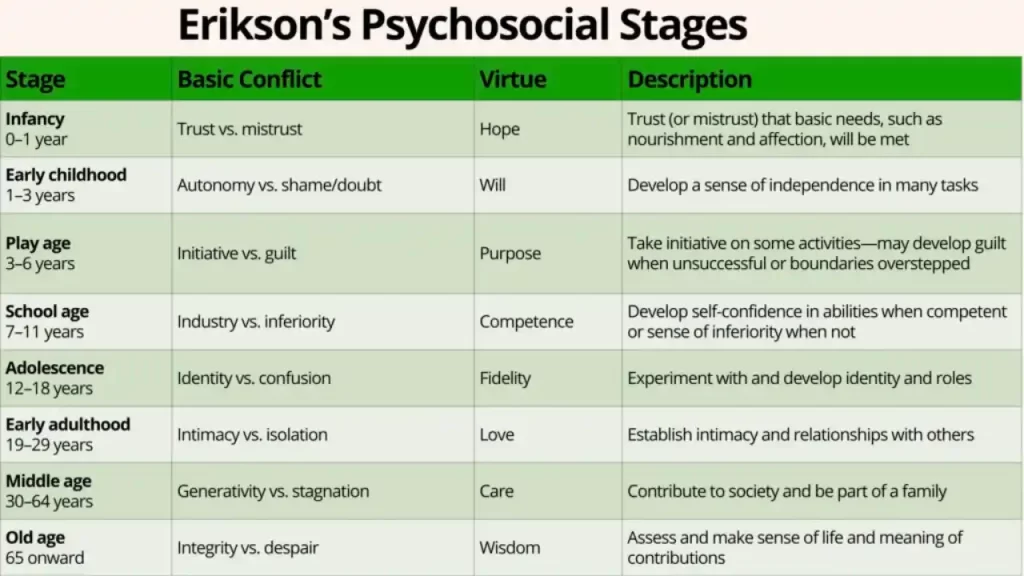
Stage 1: Trust vs. Mistrust (0–18 Months) – Building a Foundation of Security
During infancy, babies depend entirely on caregivers for stability and nurturing. How these needs are met shapes their lifelong sense of trust in the world.
Key Outcomes of Trust vs. Mistrust
✅ Trust Develops When:
- Needs (food, comfort, love) are consistently met.
- Care is reliable, creating a belief that the world is safe and predictable.
❌ Mistrust Develops When:
- Care is inconsistent, neglectful, or unpredictable.
- Leads to anxiety, insecurity, and a view of the world as unreliable.
Quick Facts
- Conflict: Trust vs. Mistrust
- Age Range: Birth to 18 months
- Key Activity: Feeding & responsive caregiving
- Virtue Gained: Hope
- Negative Outcome: Fear, anxiety, difficulty forming secure relationships
Why Trust Matters
A secure infant learns:
✔ The world is dependable.
✔ People are caring and responsive.
✔ They can explore safely, knowing support is available.
Mistrust leads to:
✖ Suspicion of others.
✖ Fear of unpredictability.
✖ Difficulty forming close bonds later in life.
How to Foster Trust in Infants
🔹 Respond promptly to cries (hunger, comfort, affection).
🔹 Use warm, soothing interactions (eye contact, gentle touch).
🔹 Establish routines for feeding, sleep, and play.
🔹 Encourage safe exploration in a nurturing environment.
🔹 Practice skin-to-skin contact to strengthen attachment.
The Role of Feeding in Building Trust
Feeding is a baby’s first major social interaction—it teaches them whether their needs will be met.
✅ Trust-Building Feeding:
- Consistent, attentive responses to hunger cues.
- Creates security and confidence in caregivers.
❌ Mistrust from Poor Feeding:
- Neglect or inconsistency causes distress.
- Leads to anxiety about basic needs being unmet.
Success vs. Failure in This Stage
🌟 Success = Hope
- Child believes future challenges will be met with support.
- Develops resilience and optimism.
⚠️ Failure = Fear
- Persistent mistrust carries into adulthood.
- May result in anxiety, insecurity, and relationship difficulties.
Research Support
Studies (Bowlby & Ainsworth) confirm:
- Early attachment quality impacts lifelong relationships.
- Balanced trust helps infants cope with stress and build resilience.
Stage 2: Autonomy vs. Shame & Doubt (18 Months–3 Years) – Building Confidence Through Independence
Toddlers begin asserting independence through choices like self-dressing and food selection. This critical stage shapes their lifelong self-confidence and decision-making abilities.
Key Outcomes of Autonomy vs. Shame
✅ Autonomy Develops When:
- Caregivers encourage exploration and self-care attempts
- Children feel supported in making simple choices
❌ Shame/Doubt Develops When:
- Caregivers are overly critical or controlling
- Children feel discouraged from trying new tasks
Quick Facts
- Conflict: Autonomy vs. Shame & Doubt
- Age Range: 18 months to 3 years
- Key Milestones: Toilet training, self-dressing, food choices
- Virtue Gained: Will (confidence to act independently)
- Negative Outcome: Low self-esteem, overdependence on others
Why This Stage Matters
A confident toddler learns:
✔ “I can do things by myself”
✔ Making choices feels good
✔ Mistakes are part of learning
Shame leads to:
✖ “I’m bad at trying new things”
✖ Fear of making decisions
✖ Constant need for approval
How to Foster Healthy Autonomy
🔹 Offer limited choices (“Apple slices or banana?”)
🔹 Celebrate attempts (“You put on your shoes all by yourself!”)
🔹 Make toilet training positive with patience and encouragement
🔹 Allow safe exploration (child-safe kitchen utensils, dress-up clothes)
🔹 Use “scaffolding” – help just enough to prevent frustration
Toilet Training: A Critical Autonomy Test
This key milestone teaches bodily control and responsibility:
✅ Autonomy-Building Approach:
- Follow child’s readiness signs
- Praise successes, normalize accidents
- Make it a teamwork experience
❌ Shame-Inducing Approach:
- Punishing accidents
- Starting before child is ready
- Showing disappointment
Success vs. Failure in Stage 2
🌟 Success = Strong Will
- Child believes in their capabilities
- Develops healthy self-reliance
⚠️ Failure = Chronic Doubt
- May avoid challenges later in life
- Struggles with decision-making as adult
Parenting Tips for This Stage
📌 Do:
- Say “Let’s try together” instead of taking over
- Create child-friendly spaces (low hooks, step stools)
- Keep instructions simple (“First pants, then shoes”)
📌 Avoid:
- “You’re too slow, I’ll do it”
- Shaming language (“Only babies have accidents”)
- Comparing to siblings/peers
Research Insights
- Erik Erikson emphasizes the “golden mean” – balancing protection with freedom
- Studies show early autonomy leads to better problem-solving skills in school years
- Positive reinforcement works better than criticism for skill acquisition
Stage 3: Initiative vs. Guilt (3–5 Years) – Nurturing Purpose Through Playful Exploration
Preschoolers burst with creativity—inventing games, asking endless “why” questions, and testing their leadership skills. How adults respond shapes their lifelong confidence to pursue ideas.
Key Outcomes of Initiative vs. Guilt
✅ Initiative Develops When:
- Adults encourage pretend play and curiosity
- Children feel safe to test ideas without fear of harsh criticism
❌ Guilt Develops When:
- Caregivers dismiss play as silly or disruptive
- Mistakes are met with shame rather than guidance
Quick Facts
- Conflict: Initiative vs. Guilt
- Age Range: 3 to 5 years
- Key Activities: Role-playing, question-asking, group play
- Virtue Gained: Purpose (drive to set and pursue goals)
- Negative Outcome: Hesitancy to lead, excessive self-doubt
Why This Stage Matters
A child with healthy initiative learns:
✔ “My ideas have value”
✔ Planning and trying new things feels exciting
✔ Mistakes help me grow
Excessive guilt causes:
✖ “I’m annoying when I ask questions”
✖ Fear of suggesting activities
✖ Over-reliance on others for direction
How to Foster Purposeful Initiative
🔹 Host “idea time” (“What game should we play?”)
🔹 Turn chores into adventures (“Be the captain who delivers laundry!”)
🔹 Use open-ended toys (blocks, dress-up clothes, art supplies)
🔹 Normalize mistakes (“Oops! Our block tower fell. What could we try next?”)
🔹 Role-model curiosity (“I wonder why leaves change color—let’s find out!”)
The Power of Play
Pretend play builds crucial life skills:
✅ Initiative-Boosting Play:
- Assign leadership roles (“You’re the doctor—how should we check Teddy’s heartbeat?”)
- Encourage storytelling (“What happens next in your spaceship adventure?”)
- Validate emotions (“Were you frustrated when your tower fell?”)
❌ Guilt-Inducing Responses:
- “Stop making up silly rules”
- “We don’t have time for your games”
- Over-correcting pretend scenarios
Success vs. Failure in Stage 3
🌟 Success = Strong Purpose
- Child becomes a confident problem-solver
- Develops natural leadership abilities
⚠️ Failure = Chronic Hesitation
- May avoid group projects or sharing ideas in school
- Struggles with self-directed learning
Parenting Scripts for This Stage
📌 Do Say:
- “That’s a creative solution!”
- “What’s your plan for building that?”
- “Even grown-ups need practice—let’s try together.”
📌 Avoid Saying:
- “You’re doing it wrong”
- “Stop asking so many questions”
- “Your game doesn’t make sense”
Research Insights
- Erik Erikson called this the “play age“—critical for developing moral reasoning
- Studies link pretend play to stronger empathy and language skills
- Children who lead games at this stage often show better executive function by age 7
Stage 4: Industry vs. Inferiority (5–12 Years) – Building Confidence & Competence in School-Age Children
As children enter elementary school, they begin comparing their skills to peers and seeking validation through achievement. This critical stage shapes their lifelong work ethic, self-esteem, and resilience.
✏️ Key Takeaways: Industry vs. Inferiority
✅ Industry Develops When:
- Children receive encouragement for effort (not just results)
- They master new skills through practice and persistence
❌ Inferiority Develops When:
- Frequent criticism or lack of support leads to self-doubt
- Constant comparison to peers makes them feel “not good enough”
📊 Stage 4 Quick Facts
| Conflict: | Industry (Competence) vs. Inferiority |
| Age Range: | 5–12 years (Elementary & Middle School) |
| Key Activities: | Schoolwork, sports, arts, peer collaboration |
| Virtue Gained: | Competence (belief in one’s abilities) |
| Negative Outcome: | Low self-esteem, fear of challenges, avoidance of effort |
🧠 Why This Stage Matters for Child Development
Children who develop industry learn:
✔ “I can improve with practice!”
✔ “Mistakes help me grow.”
✔ “My effort matters.”
Children who develop inferiority believe:
✖ “I’m just not smart/good enough.”
✖ “Why try if I’ll fail?”
✖ “Others are better than me.”
🏆 How to Foster Industry & Prevent Inferiority
For Parents & Teachers:
🔹 Praise effort, not just talent → “You studied hard for that test!”
🔹 Break tasks into steps → “Let’s tackle one problem at a time.”
🔹 Encourage hobbies & passions → Sports, music, coding, art
🔹 Normalize struggle → “Even experts were beginners once!”
🔹 Avoid comparisons → Focus on personal growth, not others’ success
📌 Positive vs. Negative Feedback Examples
❌ “You got this wrong—try again.” (Demoralizing)
✅ “I see you’re stuck. What’s one strategy we could try?” (Empowering)
❌ “Why can’t you be as fast as Sam?” (Comparison)
✅ “You’re improving every time!” (Growth mindset)
🏫 The Role of School in Industry vs. Inferiority
School is where children:
📚 Develop skills (math, reading, teamwork)
🤝 Compare themselves to peers (social ranking)
💡 Receive feedback (builds confidence or self-doubt)
✅ How Schools Can Encourage Industry
✔ Project-based learning (hands-on skill-building)
✔ Encouraging teamwork (collaborative success)
✔ Providing constructive feedback (“Next steps” vs. criticism)
❌ What Fuels Inferiority?
✖ Overemphasis on grades over effort
✖ Public shaming for mistakes
✖ Labeling kids as “slow” or “bad at __”
🎯 Success vs. Failure in Stage 4
🌟 Success = Competence
- Child believes in their ability to learn & improve
- Willing to take on challenges
- Healthy work ethic & resilience
⚠️ Failure = Inferiority Complex
- Avoids challenges due to fear of failure
- Low motivation (“Why bother?”)
- Fixed mindset (“I’m just bad at this.”)
🔍 Research & Expert Insights
- Erik Erikson’s theory shows kids need balanced feedback—encouragement + realistic guidance.
- Growth mindset research (Dweck, 2006) proves praising effort boosts resilience.
- Peer comparison peaks at ages 8–12, making teacher/parent support crucial.
Stage 5: Identity vs. Role Confusion (12-18 Years) – The Ultimate Guide to Teen Identity Formation
Adolescence marks a critical crossroads where teens ask: “Who am I?” This comprehensive guide explores how to help teenagers build a strong identity while avoiding role confusion.
🔍 Understanding Identity vs. Role Confusion
✅ Healthy Identity Development
- Teens explore values, beliefs, and future goals
- They experiment with different social roles
- Supportive guidance helps them solidify their sense of self
❌ Role Confusion Risks
- Lack of exploration leads to uncertainty about life direction
- Excessive pressure causes rebellion or identity crisis
- Weak self-concept may persist into adulthood
📊 Key Facts About This Developmental Stage
| Conflict: | Identity Formation vs. Role Confusion |
| Age Range: | 12-18 years (Middle School to High School) |
| Key Activities: | Social exploration, career consideration, values testing |
| Virtue Gained: | Fidelity (Commitment to personal values & relationships) |
| Negative Outcome: | Identity diffusion, lack of direction, low self-esteem |
🧠 Why This Stage is Crucial for Teen Development
During adolescence, the brain undergoes significant changes that affect:
- Self-perception (How teens see themselves)
- Future planning (Career and life goals)
- Social belonging (Peer acceptance vs. individuality)
📈 Long-Term Impacts
- Teens with strong identity: Better mental health, career satisfaction
- Teens with role confusion: Higher risk of anxiety, poor decision-making
💡 5 Powerful Ways to Support Teen Identity Development
1️⃣ Encourage Safe Self-Exploration
✔ Allow style experimentation (clothing, hobbies)
✔ Support extracurricular activities (arts, sports, clubs)
✔ Discuss ethical dilemmas to clarify values
2️⃣ Foster Healthy Social Connections
✔ Encourage diverse friendships
✔ Discuss peer pressure strategies
✔ Promote involvement in community groups
3️⃣ Guide Without Controlling
✔ Ask open-ended questions: “What kind of person do you want to become?”
✔ Share your own adolescent experiences
✔ Avoid rigid expectations about careers or lifestyles
4️⃣ Normalize the Identity Journey
✔ Explain that identity evolves throughout life
✔ Share stories of successful people who changed paths
✔ Validate confusion as part of the process
5️⃣ Build Emotional Resilience
✔ Teach coping skills for social challenges
✔ Encourage journaling for self-reflection
✔ Model healthy identity behaviors
⚠️ Warning Signs of Role Confusion
- Extreme conformity or rebellion
- Rapid, drastic changes in personality
- Avoidance of future planning
- Excessive dependence on peer approval
🎓 Expert Insights on Teen Identity Formation
What Research Shows
- Erik Erikson emphasized psychosocial moratorium – a “time-out” for identity exploration
- Modern studies link identity achievement to higher life satisfaction (Schwartz, 2005)
- Brain development continues until age 25, meaning identity remains flexible
Common Identity Statuses (Marcia, 1966)
- Achievement (Explored and committed)
- Foreclosure (Committed without exploration)
- Moratorium (Actively exploring)
- Diffusion (No exploration or commitment)
📌 Practical Tips for Parents & Educators
Do:
✔ Create a “judgment-free zone” for discussions
✔ Provide diverse role models
✔ Celebrate small steps in self-discovery
Avoid:
✖ Pressuring teens into specific identities
✖ Dismissing their changing interests
✖ Comparing them to siblings/peers
Stage 6: Intimacy vs. Isolation (18-40 Years) – Building Meaningful Connections
🌟 Key Life Challenge:
“Can I form loving, lasting relationships?”
📊 Quick Facts Table
| Conflict | Intimacy (Deep Connections) vs. Isolation (Loneliness) |
| Age Range | 18-40 years |
| Key Activities | Romantic partnerships, close friendships, emotional vulnerability |
| Virtue Gained | Love (Capacity for mutual care & commitment) |
| Risk Factors | Fear of vulnerability, unresolved identity issues, social anxiety |
💡 What Healthy Intimacy Looks Like
✔ Comfort with emotional vulnerability
✔ Ability to balance independence and togetherness
✔ Mutual support in relationships
✔ Resilience through conflicts
⚠️ Warning Signs of Isolation
✖ Avoiding deep relationships due to fear
✖ Serial short-term relationships without commitment
✖ Feeling lonely even in crowds
🔑 5 Ways to Build Intimacy
- Practice vulnerability – Share feelings gradually
- Develop active listening skills – Focus on understanding, not just responding
- Maintain identity in relationships – Avoid losing yourself in partnerships
- Work through conflicts constructively – See disagreements as growth opportunities
- Expand social circles – Cultivate both romantic and platonic connections
📈 Success vs. Failure Outcomes
✅ Success: Fulfilling relationships, emotional security, capacity for love
❌ Failure: Chronic loneliness, difficulty trusting others, emotional withdrawal
Stage 7: Generativity vs. Stagnation (40-65 Years) – Creating Your Legacy
🌟 Key Life Challenge:
“How will I contribute to the world?”
📊 Quick Facts Table
| Conflict | Generativity (Legacy Building) vs. Stagnation (Lack of Growth) |
| Age Range | 40-65 years |
| Key Activities | Parenting, mentoring, career development, community service |
| Virtue Gained | Care (Investment in future generations) |
| Risk Factors | Career dissatisfaction, empty nest syndrome, lack of purpose |
💡 What Generativity Looks Like
✔ Mentoring younger colleagues
✔ Volunteering or community leadership
✔ Creative pursuits that outlast you
✔ Parenting with purpose
⚠️ Warning Signs of Stagnation
✖ Feeling “stuck” in routines
✖ Excessive focus on youth/regrets
✖ Lack of interest in helping others
🔑 5 Paths to Generativity
- Become a mentor – Share your professional/life wisdom
- Reinvest in marriage – Deepen long-term partnerships
- Pursue “passion projects” – Creative or philanthropic endeavors
- Embrace lifelong learning – Take courses, develop new skills
- Practice gratitude – Reflect on accomplishments and blessings
📈 Success vs. Failure Outcomes
✅ Success: Sense of purpose, pride in contributions, continued growth
❌ Failure: Midlife crisis, bitterness, feelings of irrelevance
Stage 8: Ego Integrity vs. Despair (65+ Years) – Finding Meaning in Life’s Final Chapter
🌟 The Ultimate Life Challenge:
“Have I lived a life I can look back on with pride and peace?”
📊 Essential Facts at a Glance
| Psychological Conflict | Ego Integrity (Fulfillment) vs. Despair (Regret) |
| Age Range | 65+ years (Late Adulthood) |
| Key Activities | Life review, legacy building, mortality acceptance |
| Virtue Gained | Wisdom (Deep understanding of life’s meaning) |
| Primary Risk | Chronic regret, death anxiety, late-life depression |
🧠 Why This Stage Matters
This final developmental crossroads determines whether seniors:
✔ Achieve peaceful self-acceptance
✔ Develop existential wisdom to share with others
✔ Face mortality with dignity rather than fear
💡 Characteristics of Ego Integrity
- Ability to recount life stories with humor and perspective
- Sense of having contributed meaningfully
- Acceptance of both triumphs and failures
- Willingness to mentor younger generations
⚠️ Warning Signs of Despair
- Obsessive “what if” thinking about past choices
- Bitterness about aging and physical changes
- Refusal to discuss or acknowledge mortality
- Isolation from family/community
🔑 5 Pathways to Achieving Ego Integrity
1. Conduct a Life Review
✔ Create ethical wills or memoirs
✔ Organize photos/stories for descendants
✔ Acknowledge hardships overcome
2. Reframe Regrets
✔ View mistakes as learning experiences
✔ Practice self-forgiveness for past decisions
✔ Focus on positive impacts made
3. Engage in Legacy Work
✔ Volunteer as a community elder
✔ Share skills through intergenerational programs
✔ Establish family traditions/stories
4. Cultivate Present-Moment Awareness
✔ Practice mindfulness meditation
✔ Savor small daily pleasures
✔ Maintain social connections
5. Address Mortality Directly
✔ Complete advance care planning
✔ Discuss spiritual beliefs about death
✔ Create meaningful end-of-life rituals
📈 Success vs. Failure Outcomes
✅ Achieving Ego Integrity Leads To:
- Sense of life’s coherence and meaning
- Willingness to share hard-won wisdom
- Peaceful acceptance of life’s natural conclusion
❌ Succumbing to Despair Results In:
- Chronic regret and “if only” thinking
- Fear and avoidance of death discussions
- Emotional withdrawal from loved ones
🧓 Expert Insights on Late Life Development
Research Findings:
- Life review therapy significantly improves late-life wellbeing (Butler, 1963)
- Elders with strong intergenerational connections report higher integrity (Erikson & Erikson, 1997)
- Wisdom involves balancing acceptance with healthy discontent (Ardelt, 2000)
Common Wisdom Themes:
- Imperfection Acceptance: “I did my best with what I knew then”
- Gratitude Focus: “I’m thankful for the love I experienced”
- Legacy Perspective: “My values live on through my family”
📌 Practical Tips for Families & Caregivers
Do:
✔ Encourage reminiscence through open-ended questions
✔ Help document life stories (audio/video recordings)
✔ Validate both joys and sorrows in their narrative
Avoid:
✖ Dismissing their mortality concerns
✖ Minimizing their life achievements
✖ Rushing them through emotional processing

Critical Analysis of Erik Erikson’s Psychosocial Development Theory
🔍 Overview of Strengths and Limitations
Erik Erikson’s theory remains influential in developmental psychology, but merits careful evaluation of its empirical support and cultural applicability.
✅ Key Strengths
| Strength | Explanation | Real-World Application |
| Lifespan Perspective | First major theory to chart development from infancy to old age | Helps clinicians assess challenges across life phases |
| Practical Framework | Stages correspond to observable life transitions | Used in education, counseling, and parenting programs |
| Face Validity | Resonates with personal experiences | Clients often recognize themselves in stage descriptions |
⚠️ Major Criticisms & Modern Perspectives
1. Lack of Mechanistic Explanation
Core Issue: The theory describes what happens developmentally but not how crises are resolved.
Evidence:
- Erik Erikson himself called it “more schematic than explanatory” (1964)
- Limited guidance for interventions when stages are poorly resolved
Clinical Implication:
Therapists often combine Erik Erikson’s stages with:
- Attachment theory (for early stages)
- Cognitive-behavioral techniques (for maladaptive resolutions)
2. Rigid Stage Sequencing
Key Challenges:
- Age ranges don’t account for individual/cultural variability
- Modern life transitions (e.g., later marriage) disrupt original timeline
Research Findings:
- 35% of adults experience “recycled” identity crises (Arnett, 2000)
- Generativity activities now often begin in 30s (McAdams, 2001)
3. Cultural Limitations
Western Bias in Model:
| Erik Erikson’s Assumption | Cross-Cultural Findings |
| Identity = Individual achievement | Collectivist cultures emphasize relational identity (Markus & Kitayama, 1991) |
| Autonomy as key toddler goal | Interdependence valued more highly in many Asian/Latin American cultures |
| Generativity through career | Legacy may focus on spiritual/ancestral traditions |
Case Examples:
- Japan: “Adult children” often live with parents until marriage
- Navajo culture: Wisdom comes from harmony with nature, not personal achievement
4. Recurring Developmental Crises
Contrary to Linear Model:
- Divorce often re-triggers intimacy vs. isolation issues
- Career changes can restart identity exploration
- Retirement may renew generativity vs. stagnation dynamics
Life Course Perspective:
Modern theorists view development as:
- Multidirectional (gains/losses at all ages)
- Context-dependent (historical/cultural influences)
- Plastic (capacity for change remains)
📊 Erik Erikson vs. Maslow: Key Differences
| Factor | Erik Erikson’s Psychosocial Stages | Maslow’s Hierarchy of Needs |
| Nature | Predetermined age-linked stages | Flexible motivational pyramid |
| Progression | Stage completion depends on crisis resolution | Lower needs must be met before advancing |
| Outcome | Virtues (e.g., hope, will) at each stage | Ultimate goal of self-actualization |
| Flexibility | Relatively rigid sequence | Context-dependent progression |
| Focus | Social/emotional development | Universal human motivations |
💡 Modern Applications & Adaptations
Evidence-Based Revisions:
- Fluid Stage Transitions (Peterson, 2018)
- Cultural Variants Model (Gardiner, 2020)
- Life Narrative Approach (McAdams, 2006)
Best Practices for Use:
✔ In Clinical Settings: As assessment framework, not rigid diagnostic tool
✔ In Research: Control for cultural/cohort differences
✔ In Education: Present with complementary theories (Vygotsky, Bronfenbrenner)
Erikson vs. Freud: A Comparative Analysis of Developmental Theories
🔍 Core Differences Between Psychosexual and Psychosocial Models
📊 Side-by-Side Comparison
| Aspect | Freud’s Psychosexual Theory | Erikson’s Psychosocial Theory |
| Scope | Covers birth to puberty (5 stages) | Spans entire lifespan (8-9 stages) |
| Primary Focus | Biological drives/sexual energy | Social/cultural influences |
| Structural Emphasis | Id (instinctual impulses) | Ego (adaptive capacities) |
| Stage Progression | Resolving libidinal tensions | Mastering social challenges |
| Outcome Focus | Avoiding fixation/pathology | Developing psychosocial virtues |
| Cultural Relevance | Limited Western medical model | More adaptable to diverse contexts |
Key Advancements in Erik Erikson’s Model
- Lifespan Perspective
- Added adult developmental stages (intimacy, generativity, integrity)
- Recognized growth continues beyond adolescence
- Social Dimension
- Incorporated cultural/historical influences
- Shifted from sexual drives to identity formation
- Strengths-Based Approach
- Emphasized healthy development over pathology
- Introduced positive outcomes (virtues) for each stage
🧠 Joan Erik Erikson’s Ninth Stage: Wisdom in Extreme Old Age
Understanding Late-Stage Development (80+ Years)
Joan Erikson’s extension recognizes that advanced aging brings:
- Physical/cognitive decline requiring new adaptations
- Reassessment of earlier life resolutions
- Existential confrontation with mortality
The “Recycling” of Psychosocial Crises
| Original Stage | Revisited Challenge in 9th Stage | Key Question |
| Trust vs. Mistrust | Dependence on caregivers | “Can I trust those who now care for me?” |
| Autonomy vs. Shame | Loss of independence | “Do I still have control over my life?” |
| Industry vs. Inferiority | Changing social roles | “Am I still contributing meaningfully?” |
| Identity vs. Confusion | Shifting self-concept | “Who am I now that my roles have changed?” |
| Intimacy vs. Isolation | Bereavement and loneliness | “Will I face my final years alone?” |
Clinical Implications
- Geriatric Care: Highlights need for dignity-preserving approaches
- Life Review Therapy: Helps integrate these revisited conflicts
- Palliative Support: Addresses existential distress in terminal phases
📚 Theoretical Evolution: From Freud to the Erik Eriksons
Freud’s Lasting Contributions
- First developmental stage theory
- Concept of unconscious influences
- Importance of early childhood
Erik Erikson’s Expansions
- Beyond Biology: Incorporated social/historical factors
- Lifelong Growth: Added adult developmental tasks
- Cultural Lens: Allowed for varied expressions of identity
Joan’s Final Contribution
- Addressed limitations of original 8-stage model
- Recognized nonlinear development in late life
- Emphasized resilience in face of aging challenges
💡 Modern Applications
In Therapy
- Young Adults: Identity exploration techniques
- Midlife: Generativity coaching
- Elderly: Life review and legacy work
In Research
- Cross-cultural studies of developmental timing
- Neuroscientific investigations of stage transitions
- Longitudinal studies of psychosocial adaptation
Navigating the Ninth Stage: A Comprehensive Guide to Late-Life Development
🌅 Understanding Joan Erik Erikson’s Ninth Stage (80+ Years)
This final developmental phase presents unique challenges as elderly individuals revisit earlier psychosocial crises under new circumstances of aging and dependence.
📊 Key Characteristics of the Ninth Stage
| Feature | Description | Impact on Seniors |
| Recycled Conflicts | Earlier developmental challenges re-emerge | Requires new coping strategies |
| Physical Decline | Reduced mobility/independence | Triggers autonomy concerns |
| Social Role Shifts | Loss of work/family roles | Challenges identity maintenance |
| Mortality Salience | Increased awareness of death | Intensifies integrity/despair dynamic |
🔑 Four Core Themes of the Ninth Stage
1. Loss of Control & Rebuilding Trust
Developmental Challenge:
Reconciliation of Trust vs. Mistrust in caregiving relationships
Common Concerns:
- “Will my caregivers respect my dignity?”
- “Does my family resent my needs?”
Support Strategies:
✔ Maintain consistent care routines
✔ Involve seniors in care decisions
✔ Train caregivers in empathy-based approaches
2. Identity Reconstruction
Developmental Challenge:
Renegotiation of Identity vs. Role Confusion
Key Questions:
- “Who am I beyond my former roles?”
- “How do I matter now?”
Intervention Approaches:
- Life Story Work: Structured reminiscence therapy
- Legacy Projects: Memoirs, ethical wills, or digital storytelling
- Role Adaptation: New socially valued positions (e.g., family historian)
3. Adaptive Generativity
Developmental Challenge:
Reinvention of Generativity vs. Stagnation
Innovative Contributions:
- Oral history preservation
- Grandparent mentoring programs
- Community advocacy roles
Benefits:
→ Maintains sense of purpose
→ Creates intergenerational bonds
→ Combats social isolation
4. Final Integrity Resolution
Developmental Challenge:
Ultimate reckoning with Ego Integrity vs. Despair
Therapeutic Tools:
- Dignity Therapy: Evidence-based end-of-life intervention
- Meaning-Centered Therapy: Frankl-inspired approaches
- Symbolic Rituals: Farewell letters or blessing ceremonies
🧑⚕️ Best Practices for Caregivers & Professionals
Multidimensional Support Framework
| Domain | Interventions | Outcome Goals |
| Physical | Pain management, mobility aids | Maintain functional autonomy |
| Psychological | Life review, grief counseling | Achieve emotional resolution |
| Social | Intergenerational programs | Sustain meaningful connections |
| Spiritual | Legacy work, ritual creation | Find transcendent meaning |
Dos and Don’ts in Ninth Stage Care
✅ Do:
- Use open-ended questions about life experiences
- Create memory books/digital archives together
- Honor small choices (meal times, clothing selection)
❌ Avoid:
- Dismissing existential concerns
- Over-protection that undermines dignity
- Rushing through care tasks
📈 Measuring Successful Navigation
Positive Indicators:
- Ability to articulate life meaning
- Engagement in forward-looking activities
- Peaceful acceptance of care needs
Risk Factors:
- Persistent death anxiety
- Social withdrawal
- Expressed regret dominance
Practical Applications of Erik Erikson’s Psychosocial Theory Across Fields
🏥 Clinical & Therapeutic Applications
Psychosocial Assessment Framework
- EPSI (Erik Erikson Psychosocial Stage Inventory): Standardized tool measuring stage resolution
- Life History Interviews: Uncovering unresolved developmental crises
- Transition Mapping: Identifying current psychosocial challenges
Targeted Therapeutic Interventions
| Stage | Common Issues | Therapeutic Approaches |
| Trust vs. Mistrust | Attachment disorders | Object relations therapy |
| Identity vs. Confusion | Role transitions | Narrative identity work |
| Generativity vs. Stagnation | Midlife crisis | Legacy-building exercises |
Cultural Adaptations in Practice
- Collectivist Cultures: Emphasize family/community in identity formation
- Individualist Cultures: Focus on personal achievement in generativity
- Therapist Toolkit: Culture-specific stage milestones and rituals
👨🏫 Educational & Parenting Applications
Developmentally-Aligned Parenting Strategies
| Age Group | Key Challenge | Support Strategies |
| 0-2 years | Building trust | Consistent responsive care |
| 2-4 years | Developing autonomy | Choice offering (“red or blue shirt?”) |
| 5-12 years | Building competence | Process praise over outcome praise |
| 13-19 years | Identity formation | Exploratory opportunities |
Classroom Implementation
Elementary Schools:
- Industry-building through skill scaffolding
- Mistake-normalizing teaching practices
Secondary Schools:
- Identity exploration curricula
- Peer mentoring programs
Special Education:
- Autonomy-supportive IEP goals
- Competence-building through micro-successes
🧓 Gerontological Applications
Retirement Transition Support
- Identity Bridge Programs: Career skills → community application
- Legacy Development: Oral history projects, ethical wills
- Generativity Maintenance: Senior-youth partnership initiatives
End-of-Life Integration
- Dignity Therapy: Evidence-based life review protocol
- Existential Work: Meaning reconstruction techniques
- Family Systems Approach: Intergenerational closure processes
🔄 Cross-Cultural Adaptations
Stage Manifestation Variations
| Stage | Western Expression | Eastern Expression |
| Autonomy | Independent choice | Harmonious group decisions |
| Identity | Personal achievement | Family role fulfillment |
| Integrity | Individual life review | Ancestral connection focus |
Cultural Competence Guidelines
- Assess family decision-making norms
- Identify community-valued generativity forms
- Adapt life review methods to oral traditions
🔬 Research & Assessment Tools
Validated Measurement Instruments
- EPSI: Quantitative stage resolution assessment
- Life Story Interview: Qualitative stage analysis
- Generativity Scales: Midlife contribution measures
Current Research Frontiers
- Neuroscience of stage transitions
- Digital identity formation in adolescence
- Cross-cultural generativity expressions
📋 Implementation Checklists
For Clinicians
✔ Map presenting issues to developmental stages
✔ Use stage-appropriate intervention strategies
✔ Monitor resolution progress indicators
For Educators
✔ Align classroom activities with stage needs
✔ Provide stage-relevant feedback types
✔ Create safe exploration spaces
For Caregivers
✔ Recognize recycled conflicts in elderly
✔ Support dignity-preserving autonomy
✔ Facilitate meaningful contribution opportunities
📈 Outcome Evaluation Metrics
Successful Stage Navigation Indicators:
- Increased adaptive functioning
- Development of stage-specific virtues
- Positive future orientation
- Resilient coping strategies
Healing Unresolved Developmental Conflicts in Later Life
🔄 The Recurrence of Early Psychosocial Challenges
Erik Erikson’s theory reveals how unmet developmental needs resurface with new urgency in old age, requiring compassionate intervention.
Common Conflict Resurgences
| Original Conflict | Later-Life Manifestation | Emotional Impact |
| Trust vs. Mistrust | Fear of caregiver dependence | Anxiety about medical care |
| Autonomy vs. Shame | Resistance to assisted living | Loss of self-worth |
| Identity vs. Confusion | Post-retirement role loss | Existential questioning |
| Generativity vs. Stagnation | Unfulfilled legacy concerns | Deep regret |
🛠️ Therapeutic Approaches for Resolution
1. Life Review Therapy (Evidence-Based)
Techniques:
- Guided Autobiography: Structured memory recall sessions
- Timeline Mapping: Visual representation of life chapters
- Thematic Analysis: Identifying lifelong patterns
Benefits:
→ Integrates disjointed life experiences
→ Transforms regrets into acceptance
→ Strengthens sense of continuity
2. Legacy Intervention Methods
Project Options:
- Digital Storytelling: Creating video memoirs
- Intergenerational Dialogues: Paired conversations with youth
- Creative Legacy Workshops: Art, writing, or music compilations
Outcomes:
✓ Renewed sense of purpose
✓ Concrete contribution evidence
✓ Multigenerational connection
3. Adapted CBT for Seniors
Specialized Protocols:
- Mortality Anxiety Reduction: Cognitive restructuring exercises
- Regret Processing: Balanced reappraisal techniques
- Dependency Fear Management: Gradual exposure therapies
Session Components:
✔ Age-appropriate pacing
✔ Life experience integration
✔ Family system involvement
👵🏽👴🏼 Cultural Considerations in Treatment
Western vs. Eastern Approaches
| Aspect | Individualist Cultures | Collectivist Cultures |
| Identity Work | Personal achievement focus | Family role celebration |
| Legacy Building | Autobiographical projects | Ancestral remembrance rituals |
| Dependency Views | Independence preservation | Familial duty acceptance |
Spiritual Integration Options
- Faith-based life review (e.g., spiritual autobiographies)
- Contemplative practices (guided meditation on life transitions)
- Ritual creation (blessing ceremonies, ethical wills)
📊 Intervention Effectiveness Metrics
Positive Indicators:
- Increased life satisfaction scores
- Reduced geriatric depression scale results
- Enhanced family relationship quality
- Greater engagement in future-oriented activities
Assessment Tools:
- Geriatric Integrity Scale (self-report)
- Reminiscence Functions Scale (therapist-rated)
- Legacy Impact Measures (family feedback)
🏛️ Institutional Implementation Guide
For Care Facilities:
- Staff Training: Developmental conflict recognition
- Program Development: Weekly life review groups
- Environment Design: Memory trigger installations
For Families:
✔ Conversation starters about life meaning
✔ Collaborative legacy project planning
✔ Dignity-preserving care routines
Reference
- de Carvalho, N. A., & Veiga, F. H. (2022). Psychosocial Development Research in Adolescence: A Scoping Review. Trends in Psychology, 30(4), 640-669. UW-Madison Libraries
- Sekowski, M. (2022). Attitude Toward Death From the Perspective of Erik Erikson’s Theory of Psychosocial Ego Development: An Unused Potential. OMEGA – Journal of Death and Dying. SAGE Journals
- Samsanovich, A. (2021). Theory and Diversity: A Descriptive Study of Erikson’s Psychosocial Development Stages. Electronic Theses, Projects, and Dissertations, 1230. ScholarWorks
- Sun, X., & Sun, T. (2021). Research on Lifelong Education Based on Erikson’s Psychosocial Development Theory. Proceedings of the 2021 6th International Conference on Modern Management and Education Technology (MMET 2021), 267-270. Atlantis Press
- Rai, S. (2021). Relevance of Erik Erikson’s Model on Psychosocial Development: Recent Trends Related to Intimacy, Cheating, and Infidelity. SAGE Advance. SAGE Advance
- Herdiansyah, H., Meilana, A., Carsiwan, C., & Susilawati, D. (2024). Erikson’s Development Psychosocial Theory in the 21st Century: A Pedagogical Perspective in Physical Education. Journal of Physical Education Research, 11(1), 45-52. ResearchGate
- Gachuri, E., Adetunji, C. M., & Wanjao, J. N. (2024). The Elderly Peoples’ Perception in Reference to Their Subjective Wellbeing in Selected Mainstream Churches in Affluent Karen-Langata, Nairobi, Kenya. Journal of Aging Studies, 38, 100-110. ResearchGate
- Wisoky, M. (2024). Understanding Erikson’s Stages of Psychosocial Development. Contemporary Advances in Psychology, 15(3), 213-225. cavmonline.org
- Sekowski, M. (2022). Attitude Toward Death From the Perspective of Erik Erikson’s Theory of Psychosocial Ego Development: An Unused Potential. OMEGA – Journal of Death and Dying, 85(1), 45-61. SAGE Journals
- Liu, Y. (2024). Inspiration of Erikson’s Psychosocial Development Theory on Elderly Education in China. Lecture Notes in Education Psychology and Public Media, 33, 88-94.
See More
Unified Career Network
Synchronize your professional goals with our verified channels for exclusive TCC mentoring, career intelligence, and secure access bulletins.


