Kohlberg’s Stages of Moral Development
Key Takeaways
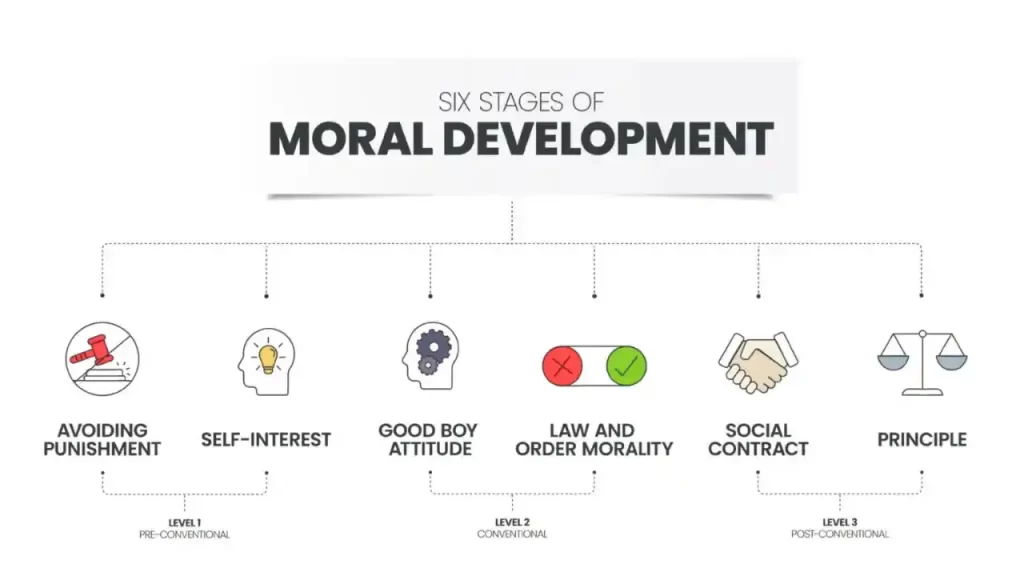
- Lawrence Kohlberg’s research revealed that people advance through six clear stages of moral understanding as they mature.
- These stages group into three main levels: pre-conventional (self-focused), conventional (social rules), and post-conventional (ethical principles).
- Each stage shows more advanced moral thinking that develops alongside mental growth and life experiences.

Kohlberg’s Three Levels of Moral Development
1. Preconventional Level (Childhood)
Focus: Self-centered decision making based on consequences
- Stage 1: Avoiding punishment (e.g., child follows rules to not get scolded)
- Stage 2: Seeking rewards (e.g., child does chores for allowance)
2. Conventional Level (Teen/Adult Years)
Focus: Social norms and rule-following
- Stage 3: Peer approval (e.g., teen dresses like friends to fit in)
- Stage 4: Law and order (e.g., adult pays taxes because it’s the law)
3. Postconventional Level (Mature Adulthood)
Focus: Personal ethics and universal principles
- Stage 5: Social good (e.g., activist protests unjust laws)
- Stage 6: Universal justice (e.g., doctor treats all patients equally regardless of background)
Real-Life Example: Cheating Dilemma
- Preconventional: “I won’t report cheating because I might get bullied”
- Conventional: “I should report cheating because it’s against school rules”
- Postconventional: “I’ll report cheating because fairness matters more than popularity”
Why This Matters:
- Shows how moral thinking evolves from childhood to adulthood
- Helps explain why people make different ethical choices
- Useful for parents/teachers guiding moral development
Level 1 – Preconventional Morality (Ages 4-9)
What is Preconventional Morality?
The earliest stage where children learn right/wrong through external consequences rather than personal ethics.
Key Characteristics:
✔ Moral rules come from authority figures (parents/teachers)
✔ Decisions based on rewards vs. punishments
✔ Self-focused – “good” = benefits me, “bad” = hurts me
Real-Life Examples:
- A 5-year-old shares toys only if praised
- A child avoids hitting to escape timeout
Stage 1: Obedience & Punishment
Moral Thinking:
➔ Rules = absolute commands
➔ “Bad” = whatever gets punished
➔ No understanding of intentions
Example:
A 1st grader follows classroom rules strictly to avoid scolding, not because they value cooperation.
Stage 2: Self-Interest
Moral Thinking:
➔ “What’s in it for me?”
➔ Limited give-and-take (e.g., “I’ll help if you pay me”)
➔ No deeper ethical principles
Example:
A child does chores only when offered ice cream, not from responsibility.
Why This Matters for Parents/Teachers
- Helps adults set clear rewards/consequences
- Explains why young kids can’t grasp abstract ethics yet
- Guides age-appropriate moral lessons
Level 2 – Conventional Morality (Ages 10-Adulthood)
Understand What is Conventional Morality
The intermediate stage where moral decisions focus on social approval, relationships, and laws rather than personal gain.
Key Characteristics:
✔ Moral choices based on group norms and societal rules
✔ Strong desire to be seen as a “good person” by others
✔ Respect for authority and social order
✔ Common in teens and most adults
Stage 3: Good Relationships (The “Nice Person” Phase)
Moral Thinking:
➔ “What will others think of me?”
➔ Acts to gain approval from friends/family
➔ Values being kind, trustworthy, and likable
Example:
A teen volunteers at a food bank because their friends admire charitable people (not just for college applications).
Stage 4: Law & Order (The “Responsible Citizen” Phase)
Moral Thinking:
➔ “Rules exist for society’s safety”
➔ Follows laws even if no one is watching
➔ Believes duty and order prevent chaos
Example:
An adult pays taxes not just to avoid fines, but because they believe it supports schools and hospitals.
Why This Matters
- Explains why teens care deeply about peer opinions
- Helps teachers/parents frame moral lessons about social responsibility
- Shows how societies maintain stability through shared rules
Level 3 – Postconventional Morality (Advanced Ethical Reasoning)
Understanding Postconventional Thinking
The highest stage in Kohlberg’s model where individuals develop personal ethical codes beyond societal norms. Only 10-15% of adults reach this advanced level of moral reasoning.
Key Characteristics:
✔ Decisions based on universal principles (justice, human rights)
✔ Willingness to challenge unjust laws
✔ Focus on ethical consistency over social approval
✔ Requires abstract thinking skills
Stage 5: Social Contract (The “Ethical Reformer” Phase)
Moral Thinking:
➔ Laws should benefit society but can be changed if unjust
➔ Values individual rights within social systems
➔ Recognizes moral gray areas
Example:
A journalist exposes corporate corruption despite legal risks, believing truth serves society.
Stage 6: Universal Principles (The “Moral Philosopher” Phase)
Moral Thinking:
➔ Follows self-chosen ethical codes
➔ Prioritizes human dignity over all laws
➔ Rarely achieved (Kohlberg doubted many reach this)
Example:
A whistleblower risks prison to reveal war crimes, valuing justice above personal safety.
Real-World Applications
- Human Rights Advocacy
- Defending equality even when unpopular
- Ethical Leadership
- CEOs prioritizing worker dignity over profits
- Social Justice Movements
- Peaceful protests challenging discriminatory laws
The Heinz Dilemma: Kohlberg’s Famous Moral Test
What Was the Heinz Dilemma?
Kohlberg’s classic moral scenario where a man must choose between:
✔ Stealing an overpriced drug to save his dying wife
✔ Obeying the law and letting her die
Why This Dilemma Matters
- Reveals how people justify moral choices
- Shows differences between rule-following vs. ethical reasoning
- Helped Kohlberg develop his 6-stage moral development theory
The Original Story (1958 Study)
Scenario:
- Heinz’s wife has terminal cancer
- A local chemist created a life-saving drug
- The drug costs 10x its production price
- Heinz can only pay half after begging friends
- The chemist refuses to lower the price or accept partial payment
The Crucial Question:
“Should Heinz steal the drug? Why/why not?”
How Kohlberg Used This Dilemma
- Research Method:
- Presented this story to children and adults
- Analyzed their reasoning (not just their yes/no answers)
- Key Findings:
- Preconventional thinkers: “Stealing is bad because Heinz will go to jail”
- Conventional thinkers: “Good husbands protect their wives, but stealing harms social order”
- Postconventional thinkers: “Life is more valuable than profit; the chemist is unethical”
- Big Insight:
- Moral maturity depends on how people justify decisions, not the decision itself
Modern Applications
- Ethics Education: Used in philosophy/psychology classes worldwide
- AI Development: Helps program moral decision-making in machines
- Leadership Training: Teaches ethical problem-solving frameworks

Kohlberg’s Key Questions in the Heinz Dilemma Study
Kohlberg posed critical moral questions to participants:
✔ Should Heinz steal the drug to save his wife?
✔ Would it matter if Heinz didn’t love his wife?
✔ Should the chemist be arrested if the woman dies?
These questions revealed how moral reasoning evolves with age.
Groundbreaking 20-Year Study
- Participants: 72 Chicago boys (aged 10-16)
- Method: 2-hour interviews analyzing 10 moral dilemmas
- Focus: Not what they decided, but why (their reasoning process)
- Longitudinal Data: 58 boys tracked for 20 years (Kohlberg, 1984)

3 Discovered Levels of Moral Development
- Preconventional (Self-interest driven)
- Conventional (Social rules focused)
- Postconventional (Ethical principles based)
Key Findings:
→ Stages progress in fixed order
→ Not everyone reaches highest stages
→ Reasoning methods replace previous ones
Kohlberg’s Stages of Moral Reasoning Explained Through the Heinz Dilemma
Level 1: Preconventional Morality (Self-Focused)
Stage 1: Avoiding Punishment
- Definition: Right/wrong depends on consequences.
- Heinz Response: “No, stealing is illegal—he’ll go to jail.”
Stage 2: Self-Interest
- Definition: Acts are judged by personal benefit.
- Heinz Response: “No, the risks outweigh the rewards.”
Level 2: Conventional Morality (Society-Focused)
Stage 3: Seeking Approval
- Definition: Good behavior = meeting social expectations.
- Heinz Response: “Yes, a good husband saves his wife at all costs.”
Stage 4: Law & Order
- Definition: Rules maintain societal stability.
- Heinz Response: “No, breaking laws harms social order.”
Level 3: Postconventional Morality (Principle-Focused)
Stage 5: Social Contract
- Definition: Laws should serve justice, not blind obedience.
- Heinz Response: “Yes, life matters more than profit.”
Stage 6: Universal Ethics
- Definition: Justice transcends laws.
- Heinz Response: “Negotiate first, but human dignity justifies defiance.”
Why This Matters Today
- For Parents: Shows how kids’ moral reasoning evolves
- For Educators: Framework for ethics discussions
- For Leaders: Explains why people debate laws vs. justice
The Role of Disequilibrium in Moral Development
Disequilibrium is essential in Kohlberg’s theory—it pushes individuals to advance through moral stages. When faced with conflicting viewpoints, people recognize gaps in their reasoning, prompting growth.
Perspective-taking improves with age:
- Preconventional level: Focuses on personal consequences (“Will I get punished?”)
- Conventional level: Considers societal expectations (“What will others think?”)
- Postconventional level: Balances justice and ethics (“Is this fair for everyone?”)
Criticisms of Kohlberg’s Methods
1. Artificial Dilemmas (Low Ecological Validity)
- Problem: Hypothetical scenarios (like Heinz’s dilemma) don’t reflect real-life decisions.
- Example: A teenager has no experience with life-or-death theft dilemmas.
- Impact: Results may not predict real-world moral behavior.
2. Gender Bias (Male-Dominated Sample)
- Kohlberg’s Claim: Men progress further in moral reasoning (justice-based).
- Gilligan’s Critique (1982): Women prioritize care and relationships, not just abstract rules.
- Example: Women might oppose theft in Heinz’s case to keep families intact.
3. Hypothetical vs. Real-Life Morality
- Issue: People reason differently in labs vs. actual crises.
- Example: Someone might condemn stealing in theory but do it to save a loved one.
- Solution: Modern studies use real-life moral narratives (Walker & Pitts, 1995).
4. Flawed Research Design
- Shortcoming: Kohlberg used cross-sectional (different ages) vs. longitudinal (same people over time) studies.
- Later Support: Colby et al. (1983) tracked 58 men for 27 years, confirming stage order.
Modern Approaches to Moral Development
✔ Narrative Analysis (Tappan, 1996): Studies how people storytell moral choices.
✔ Life Interviews (Colby & Damon, 1992): Examines real moral exemplars (e.g., activists).
✔ Open-Ended Dilemmas (Walker & Pitts, 1995): Asks about personal moral conflicts.
Critical Issues with Kohlberg’s Theory of Moral Development
1. Questioning Distinct Moral Stages
Kohlberg proposed fixed stages, but research shows inconsistencies:
- People often switch between stages depending on the situation (Rest, 1979)
- 1 in 14 individuals regressed to earlier stages
- Theory may reflect Western cultural bias rather than universal truths
Key Problem: Moral reasoning appears more situational than stage-based.
2. The Judgment-Behavior Gap
While Kohlberg linked reasoning to actions, real-world factors intervene:
- Personal habits and self-interest (Bee, 1994)
- Peer pressure and social costs
- Immediate context vs. abstract principles
Example: Someone may condemn theft theoretically but steal to feed their family.
3. Overemphasis on Justice
Kohlberg prioritized justice, but Gilligan (1982) revealed critical flaws:
- Women’s “ethics of care” (compassion, relationships) was labeled as “deficient”
- Traditional female virtues (nurturing, empathy) were misclassified as Stage 3 reasoning
- Gilligan’s Fix: Care and justice are complementary moral frameworks
4. Neglect of Emotions & Culture
- Overly Rational: Theory ignores emotional, intuitive decision-making (Walker et al., 1995)
- Cultural Bias:
- Individualist cultures (US/Europe) align with postconventional stages
- Collectivist cultures (East Asia) value harmony over abstract justice (Snarey, 1985)
5. Neo-Kohlbergian Revisions: Schema Theory
Rest et al. (1979) proposed a flexible alternative:
- Moral Schemas (not rigid stages):
- Personal Interest (“What helps me?”)
- Maintaining Norms (“Follow the rules”)
- Postconventional (“Justice for all”)
- Key Improvement: People use multiple schemas contextually.
Alternative Theories of Moral Development: Beyond Kohlberg
While Kohlberg’s stage theory is foundational, moral growth is complex and influenced by cognitive, social, and emotional factors. Here are five key alternative models that expand our understanding.
1. Piaget’s Two-Stage Model
Foundational to Kohlberg, Piaget identified two moral phases in children:
Heteronomous Morality (Ages 4–7)
- Rules are fixed (set by authority).
- Judges actions by consequences, not intent.
- Example: A child thinks breaking 3 cups accidentally is worse than breaking 1 cup on purpose.
Autonomous Morality (Ages 8+)
- Rules are flexible (socially agreed).
- Considers intentions over outcomes.
- Example: Breaking 1 cup carelessly is worse than 3 by accident.
Key thinking: Peer interactions (not just authority) drive moral growth.
2. Bandura’s Social Learning Theory
Moral behavior is learned through observation:
✔ Vicarious Reinforcement: Copy rewarded actions, avoid punished ones.
✔ Role Models: Kids imitate parents/peers they admire.
✔ Self-Efficacy: “I can act morally because I’ve seen others do it.”
Why It Matters: Moral actions depend more on social context than abstract reasoning.
3. Eisenberg’s Prosocial Reasoning
Focuses on helping others at personal cost:
- Stages: From selfish (“What’s in it for me?”) to empathetic (“They need help”).
- Role of Emotion: Empathy drives moral choices as much as logic.
- Example: Sharing food with a hungry classmate despite having less.
Key Difference: Less about rules, more about compassion.
4. Haidt’s Social Intuitionist Model
Moral decisions are gut reactions, not just logic:
- Quick Judgments: Disgust/fear shape morality before reasoning kicks in.
- Cultural Influence: Values like purity, loyalty, fairness vary globally.
- Example: Rejecting unfairness feels instinctive, not calculated.
Critique of Kohlberg: Overemphasized reasoning, ignored emotions.
5. Moral Reasoning & Well-Being (Positive Psychology)
Higher moral stages link to life satisfaction:
- Eudaimonia: Acting on ethics (justice, care) brings meaning.
- Positive Emotions: Gratitude, empathy reinforce prosocial behavior.
- Example: Volunteering feels rewarding, encouraging more moral actions.
Takeaway: Morality isn’t just thinking—it’s feeling and doing good.
Practical Applications of Kohlberg’s Theory in Real-World Settings
Kohlberg’s stages of moral development—and their critiques—offer actionable strategies for educators, students, and professionals. Here’s how to apply them effectively:
📚 In Educational Settings
1. Moral Dilemma Discussions
✔ Method: Present age-appropriate ethical scenarios (e.g., “Is cheating ever justified?”).
✔ Goal: Move students from rule-based thinking (Stage 4) to principled reasoning (Stages 5-6).
✔ Example: Debate whether a student should report a friend for cheating—weighing fairness vs. loyalty.
2. Role-Playing & Perspective-Taking
✔ Activity: Simulate conflicts (e.g., environmental protests, school policy debates).
✔ Impact: Builds empathy and helps students see multiple moral viewpoints.
✔ Example: Assign roles (activist, policymaker, skeptic) to explore justice vs. order.
3. Strengths-Based Moral Growth
✔ Link to Kohlberg: Positive psychology traits align with moral stages:
- Fairness/Justice → Stages 4-5 (law & social contracts)
- Kindness/Empathy → Stage 3 (“good person” morality) & Stage 6 (universal care)
- Wisdom/Perspective → Bridges societal norms to ethical principles
✔ Practical Tip: Use character strength assessments (Peterson & Seligman, 2004) to guide moral education.
💼 For Professionals (Business, Healthcare, Leadership)
1. Ethics Training Programs
✔ Workshops: Use Kohlberg’s dilemmas to discuss workplace ethics (e.g., whistleblowing).
✔ Outcome: Encourages postconventional reasoning (e.g., “How does this decision impact society?”).
2. Conflict Resolution Frameworks
✔ Apply Stage Theory:
- Preconventional (Stages 1-2): Address self-interest/punishment fears.
- Conventional (Stages 3-4): Appeal to team norms or company policies.
- Postconventional (Stages 5-6): Discuss long-term ethical consequences.
✔ Example: Mediating a dispute by highlighting both rules (Stage 4) and fairness (Stage 5).
3. Hiring & Team Development
✔ Assess Moral Reasoning: Use scenario-based interviews to gauge candidates’ ethical frameworks.
✔ Build Diverse Teams: Mix conventional (process-oriented) and postconventional (innovative) thinkers.
🏠 For Parents & Caregivers
1. Age-Appropriate Moral Lessons
✔ Ages 4-10: Focus on fairness vs. consequences (Piaget’s heteronomous → autonomous shift).
✔ Teens: Discuss social contracts (e.g., “Why do we have laws?”).
2. Modeling & Reinforcement
✔ Show, Don’t Just Tell: Demonstrate kindness, honesty, and ethical consistency.
✔ Reward Growth: Praise efforts to consider others’ perspectives (not just “good behavior”).
Effective Moral Development Activities & Positive Interventions
Values Reflection for Stronger Ethical Growth
- Encourage participants to identify and reflect on core values such as honesty, integrity, and generosity.
- Discuss how these values evolve across Kohlberg’s moral development stages, from basic rule-following to advanced ethical decision-making.
Gratitude Journaling for Moral Awareness
- Guide individuals to document moments of moral significance each week, such as witnessing or performing acts of kindness.
- Reinforce prosocial behaviors by linking gratitude to ethical thinking, supporting higher-level moral reasoning (Stages 5–6).
Service-Learning for Real-World Moral Application
- Engage in community service projects (e.g., volunteering, environmental initiatives) that connect ethical action to social responsibility.
- Follow up with structured reflections on how these experiences shape moral decision-making and empathy development.
Why These Strategies Matter
Moral growth is not just about knowing right from wrong—it’s about being inspired to act ethically. These positive psychology techniques align with Kohlberg’s theory of moral development, enhancing both emotional intelligence and real-world ethical engagement.
Parenting & Child Development: Raising Ethical Thinkers
- Modeling Moral Behavior: Children absorb values by observing consistent actions—demonstrating fairness and kindness is more impactful than lectures.
- Building Empathy: Hands-on experiences like volunteering, teamwork, and caring for pets nurture emotional intelligence and compassion-driven decision-making.
Ethics Training for Professionals
- Ethics Workshops: Professionals in healthcare, business, and law can analyze real-world dilemmas to strengthen post-conventional moral reasoning—balancing justice, autonomy, and ethical leadership.
- Reflective Journals: Encourage employees to document and evaluate ethical challenges in their work, fostering critical thinking and moral accountability.
References
- Dahl, A., & Killen, M. (2018). Moral reasoning: Theory and research in developmental science. Annual Review of Developmental Psychology, 1, 79–99. https://doi.org/10.1146/annurev-devpsych-121318-085033**
- Decety, J., & Cowell, J. M. (2018). Interpersonal harm aversion as a necessary foundation for morality: A developmental neuroscience perspective. Developmental Psychobiology, 60(4), 390–402. https://doi.org/10.1002/dev.21570**
- Gibbs, J. C. (2019). Moral development and reality: Beyond the theories of Kohlberg and Hoffman (4th ed.). Oxford University Press.
- Krettenauer, T., & Victor, R. (2021). Why be moral? Moral motivation across the lifespan. Developmental Review, 60, 100957. https://doi.org/10.1016/j.dr.2021.100957**
- Tomasello, M. (2022). The moral psychology of obligation. Harvard University Press.
- Bandura, A. (1977). Social learning theory. Prentice Hall.
- Bee, H. L. (1994). Lifespan development. HarperCollins College Publishers.
- Blum, L. A. (1988). Gilligan and Kohlberg: Implications for moral theory. Ethics, 98(3), 472–491. https://doi.org/10.1086/292966
- Colby, A., Kohlberg, L., Gibbs, J., & Lieberman, M. (1983). A longitudinal study of moral judgment. Monographs of the Society for Research in Child Development, 48(1-2, Serial No. 200). University of Chicago Press.
- Day, J. M., & Tappan, M. B. (1996). The narrative approach to moral development: From the epistemic subject to dialogical selves. Human Development, 39(2), 67–82. https://doi.org/10.1159/000278299
- Eisenberg, N. (1982). The development of prosocial behavior. Academic Press.
- Eisenberg, N., & Mussen, P. H. (1989). The roots of prosocial behavior in children. Cambridge University Press.
- Gilligan, C. (1977). In a different voice: Women’s conceptions of self and of morality. Harvard Educational Review, 47(4), 481–517.
- Gilligan, C. (1982). In a different voice. Harvard University Press.
- Gilligan, C. (1995). Hearing the difference: Theorizing connection. Hypatia, 10(2), 120–127. https://doi.org/10.1111/j.1527-2001.1995.tb01370.x
- Haidt, J. (2001). The emotional dog and its rational tail: A social intuitionist approach to moral judgment. Psychological Review, 108(4), 814–834. https://doi.org/10.1037/0033-295X.108.4.814
- Jorgensen, G. (2006). Kohlberg and Gilligan: Duet or duel? Journal of Moral Education, 35(2), 179–196. https://doi.org/10.1080/03057240600681710
- Kohlberg, L. (1958). The development of modes of thinking and choices in years 10 to 16 [Doctoral dissertation, University of Chicago].
- Kohlberg, L. (1984). The psychology of moral development: The nature and validity of moral stages (Essays on Moral Development, Vol. 2). Harper & Row.
- Peterson, C., & Seligman, M. E. P. (2004). Character strengths and virtues: A handbook and classification. Oxford University Press.
- Piaget, J. (1932). The moral judgment of the child. Kegan Paul, Trench, Trubner & Co.
- Rest, J. R. (1979). Development in judging moral issues. University of Minnesota Press.
- Rosen, B. (1980). Moral dilemmas and their treatment. In B. Munsey (Ed.), Moral development, moral education, and Kohlberg (pp. 232–263). Religious Education Press.
- Seligman, M. E. P., & Csikszentmihalyi, M. (2000). Positive psychology: An introduction. American Psychologist, 55(1), 5–14. https://doi.org/10.1037/0003-066X.55.1.5
- Snarey, J. R. (1985). Cross-cultural universality of social-moral development: A critical review of Kohlbergian research. Psychological Bulletin, 97(2), 202–232. https://doi.org/10.1037/0033-2909.97.2.202
- Walker, L. J., Pitts, R. C., Hennig, K. H., & Matsuba, M. K. (1995). Reasoning about morality and real-life moral problems. Psychology Press.
See More
Global Liaison Portal
Secure your professional trajectory through our verified technical networks. Access official TCC intelligence and expert career roadmaps.
Learn Psychology in Everyday Life